
Teresa Halbach and Ryan Hillegas: the two dated "for five years or so," stretching through the end of high school and part of college (Teresa and Ryan were both born in March 1980; however, Teresa graduated in May 2002 from the University of Wisconsin-Green Bay, and Ryan graduated three years later, in 2005, from the University of Wisconsin-Oshkosh).

In HDTV it looks like Ryan has a black and blue bruise just below his hat, between his left eye and ear (click on image for video); it could be a bite mark.
Ryan Hillegas' Cross Examination (Excerpt):
Q. Okay. Now, did the investigators ask you any questions about the nature of your relationship with Teresa?
A. Yeah.
Q. And they learned that you were a former boyfriend, stayed good friends with her?
A. Well, I believe I just said that I was a friend of hers. I don’t think I mentioned that I was an ex-boyfriend.
Q. Okay. And they didn’t pursue that and ask if you had ever had anything more than a friendship, is that what you are saying?
A. I believe so. It came out eventually, I just didn’t feel that it mattered.
(Court reporter coughing, asked him to repeat.)
Q. Let me try again.
A. Ask it again, please.
Q. Did the police ever probe further and ask if you had — the nature of your relationship with her beyond whether there was ever anything more than friendship?
A. I don’t think they really probed into that. I mean, I don’t remember when it came out or who was the one that mentioned that we used to date.
Q. Okay. But it wasn’t talked about that night?
A. I don’t believe so.
Q. When they were trying to find out what was happening — or what had happened to this missing person, right?
A. Yeah.
November 9, 2005, Greenbay Press Gazette:
"Hillegas..... works closely with Police. He meets with them daily. They tell him the areas to search, what would be helpful and what would be 'getting in the way.' And he stays in touch with them by cell phone."
August 6, 2006, The Post Crescent:
"Calumet County Sgt. Mark Weigert and Ryan Hillegas, a friend of Halbach's who coordinated the volunteer searchers, testified that police did not direct the search or give any instructions to searchers."

In a rare interview with TheLipTV (video below) in February 2016 (other than social media, Zellner has been tight-lipped with press), she explained what compelled her to take the case, saying that she “intends to prove” who killed Teresa Halbach, and that it’s “fairly obvious” who did it if you review the evidence in the criminal case. “It’s the evidence,” she asserted to TheLipTV. “In having had a number of these cases, it has the signature of a wrongful conviction case. They only focused on Steven Avery. They did not look at a lot of other suspects, certainly some very key people they should have been looking at. There was a very poor investigation done of the victim’s background, who she was involved with, the circumstances of her life. It had all of the hallmarks of a wrongful conviction case.”
Steven Avery's attorney, Kathleen Zellner, wrote in her motion for post-conviction relief that the correct explanation of the blood spatter on the rear cargo door of Teresa Halbach's RAV-4 would have provided a completely different scenario of the attack upon her than the one presented by Ken Kratz.
Zellner's expert, Stuart H. James, says that the blood spatter on the inside of the rear cargo door was the result of Teresa being struck with an object consistent with a hammer or mallet while she was lying on her back on the ground behind the vehicle after the rear cargo door was opened.
State's biggest blood spatter error. TH was hit on head when she stopped & opened rear cargo door #MakingAMurderer - Kathleen Zellner, Twitter, July 8, 2017The following is from Zellner's June 7th motion for post-conviction relief (not in the exact order as it appears in the petition).
A blood spatter expert has refuted the testimony of the State's expert, Nick Stahlke, that the blood spatter on the rear cargo door was created when Ms. Halbach was thrown into the rear cargo area of the RAV-4.
Stuart H. James, a forensic scientist and bloodstain pattern analyst with James and Associates Forensic Consultants, Inc. in Fort Lauderdale, Florida, opines that Mr. Stahlke mistakenly described the blood on the rear cargo door as having been projected from Ms. Halbach's bloodied hair after she had been shot and as she was thrown into the cargo area of the vehicle.
Mr. James, by overseeing a series of experiments, opines that the State's description of the cause of the blood spatter on the rear cargo door, resulting from Ms. Halbach being thrown into the cargo area and blood being projected from her bloodied hair on the cargo door, is demonstrably false. The erroneous blood spatter testimony of the State's expert Mr. Stahlke resulted in the State presenting a false narrative to the jury about the sequence of events surrounding the attack on Ms. Halbach. The State presented a scenario where Ms. Halbach was already fatally injured in Mr. Avery's garage prior to being thrown in the back of the RAV-4.
Mr. James will demonstrate that Ms. Halbach was behind her car and the cargo door was open when she was attacked. The experiments overseen by Mr. James demonstrate that Ms. Halbach was struck on the head after she opened the rear cargo door. She fell to the ground next to the rear bumper on the driver's side where she was struck repeatedly by an object similar to a mallet or hammer.
Ryan Hillegas has no alibi for October 31, 2005, the date Ms. Halbach was murdered, or the subsequent days when her body was burned and bones planted. Mr. Hillegas was never asked by law enforcement to provide an alibi for October 31, 2005. Trial defense counsel failed to conduct any substantive investigation of Mr. Hillegas, choosing to name him as a potential suspect at one point but failing to meet the requirements of Denny.
Mr. Hillegas' cell phone records show significant gaps during time periods in question. On October 31, 2005, there was a six hour gap -- a time frame in which there were neither incoming nor outgoing calls -- from 9:41 a. m. to 3:48 p.m. It is most likely that, during this time frame, Ms. Halbach departed the Avery property, departed the Zipperer property, and was killed after she arrived home at approximately 3:40-3:50 p.m. Ms. Halbach's day planner indicated that she wanted to "get Sarah's stuff from mom" at about 3 p.m. and "do biz paperwork" at approximately 4:30 p.m. Also on October 31, there was an over two-hour gap in Mr. Hillegas' phone records from 3:50 p.m. to 6:01 p.m.
Mr. Hillegas' phone records have an over 17-hour gap from 7:47 p.m. on October 31, 2005, to 1:31 p.m. on November 1, 2005, during the time where Ms. Halbach's body was transported and burned. Subsequently, Mr. Hillegas had more suspicious gaps in calls. There was a six-hour gap in phone activity on November 2, 2005, from 10:06 a.m. to 4:12 p.m., and a gap on November 3, 2005, from 7:31 p.m. to 8:10 p.m, the time when Mr. Avery reported seeing


Knowing that he was likely to be a prime suspect due to his prior romantic relationship with Ms. Halbach, the killer, who was highly organized, devised a plan to burn the body and plant evidence which would focus law enforcement on someone else.
Because the killer found appointment details in the paperwork in the RAV-4, he knew Ms. Halbach had an appointment with Mr. Avery earlier that afternoon. The killer formulated a plan to move the body and the vehicle near the Avery property, with the intent of planting the RAV-4 on the Avery property and Ms. Halbach's bones and electronic components as soon as the body and electronic components were burned in the adjacent gravel pit [the Radandt Pit owned by Badgerlands Aggregate, formerly Fred Radandt & Sons].


The killer was familiar with the Radandt and Manitowoc County pit [images above]. He devised a plan to bring the RAV-4 to the Avery property. His chief objective was to plant the vehicle on the Avery property.
The killer would have been familiar with Mr. Avery and his fame as a wrongfully convicted exoneree who was suing Manitowoc County.
The killer was organized and methodical, and likely had a background in science. He knew that he needed to put something with the DNA of Mr. Avery in the RAV-4.
On November 3, the killer learned vital information from law enforcement during his police interview. He quickly realized that law enforcement was focused on Mr. Avery and not on him.
At approximately 7:30 p.m. [on Thursday, November 3rd], Mr. Avery was exiting the Avery property onto Highway 147 when he observed taillights of a vehicle close to the front of his trailer. Mr. Avery contends that the only way the vehicle could enter his property from the direction it was pointed was if it was driven by way of Kuss Road and then across the field to the front of his trailer. Mr. Avery believes the vehicle's taillights were similar to those of the RAV-4 and not a squad car. Mr. Avery instructed his brother Chuck to turn around and drive back to the trailer, but by the time they drove back to Mr. Avery's trailer, the vehicle had departed into the darkness. (Mr. Avery and Chuck went to Menards and the county jail to drop off money for Mr. Avery's girlfriend. Mr. Avery arrived home at approximately 10:00-10:30 p.m. Mr. Avery did not enter the bathroom and went straight to bed.)


The metal post that the killer hit with Teresa's RAV-4 around 7:30 PM on November 3rd as he was attempting to plant it near Avery's trailer after driving it from the cul-de-sac at Kuss Road and across the field road bordering the Avery property
Northwest of Mr. Avery's trailer, between the Avery property and the cul-de-sac at Kuss Road, there was a metal post protruding approximately 2 ½ feet from the ground. When the killer attempted to plant Ms. Halbach's vehicle near Mr. Avery's trailer, he collided with this post, causing the damage to the front end of Ms. Halbach's RAV-4 and knocking out the driver's side parking light. He recognized the need to retrieve the parking light because leaving it, or any pieces of it, in the field would show the RAV-4 left the Avery property, contrary to Mr. Kratz's theory that the RAV-4 never left the Avery property. (Evidence from the scent and cadaver dogs supports the conclusion that the killer drove the RAV-4 onto the Avery property from Kuss Road, across a field to the vicinity of Mr. Avery's trailer.)
Once Mr. Avery departed, the killer began to drive the RAV-4 onto the Avery property. When Mr. Avery spotted the RAV-4's taillights and turned around and drove back to check it out, the killer retreated to Kuss Road. Once Mr. Avery left again, the killer drove back to the trailer. The south door on the east side of Mr. Avery's trailer was unlocked, and the killer entered the trailer, intent on finding an item of Mr. Avery's with his DNA that he could use to plant DNA in the RAV-4 to connect Mr. Avery to Ms. Halbach's murder. In the small trailer, the killer noticed fresh blood in the bathroom sink.

The killer recognized from his scientific background that if this blood was in Ms. Halbach's RAV-4, Mr. Avery would immediately become the only suspect. The killer quickly collected the blood from the sink in Mr. Avery's bathroom and deposited the blood in several spots throughout the RAV-4. The killer recognized that the blood had to be planted quickly, within 15-28 minutes and before it coagulated. He then hid the RAV-4 in the vicinity of the Kuss Road cul-de-sac.
Only someone who committed the murder and/or was involved in the effort to plant the vehicle on the Avery property would know the significance of the broken parking light and that it had been placed in the RAV-4 to conceal the fact that the vehicle was moved onto Mr. Avery's property from elsewhere.
When Mr. Hillegas volunteered false information about when the parking light damage occurred, it raised red flags about his involvement in the murder and the effort to frame Mr. Avery.
Mr. Hillegas intentionally diverted investigators by reporting that the damage to the driver's side bumper and parking light of Ms. Halbach's RAV-4 occurred months before her disappearance and that she had filed an insurance claim for the damage. Current post-conviction counsel, through its investigator, has confirmed that Ms. Halbach never filed an insurance claim for this damage to her vehicle, and further contends that the damage to Ms. Halbach's vehicle occurred after she left the Avery property on October 31, 2005.
The most reasonable explanation for Mr. Hillegas' intentional misleading of law enforcement regarding the damage to Ms. Halbach's parking light is that Mr. Hillegas wanted to divert attention from the parking light that was tossed in the rear cargo area of the RAV-4 by the killer when he was trying to plant the car on Mr. Avery's property and inadvertently hit a post on Radandt's property. Mr. Hillegas would not want the searchers looking for other pieces of the parking light on the Radandt property because, if those pieces were found, it would destroy the State's narrative that, after the murder, the RAV-4 never left the Avery property. If the narrative implicating Mr. Avery was refuted, the investigators might begin looking at more likely suspects such as Mr. Hillegas himself.
Certainly, Mr. Hillegas had no motive to frame Mr. Avery unless he himself murdered Ms. Halbach. It is difficult to imagine a much more compelling motive to frame Mr. Avery than the one possessed by the murderer of Ms. Halbach. The alleged motive, presented by trial defense counsel, that MCSD investigators were trying to derail Mr. Avery's civil rights lawsuit against them, pales in comparison to the killer's motive to frame Mr. Avery.
Mr. Hillegas was aware of Sheriff Pagel's intention to conduct aerial surveillance of the Avery property and surrounding properties on November 4, 2005, to search for Ms. Halbach's vehicle.
On November 4, the killer decided to make another attempt to plant the vehicle.

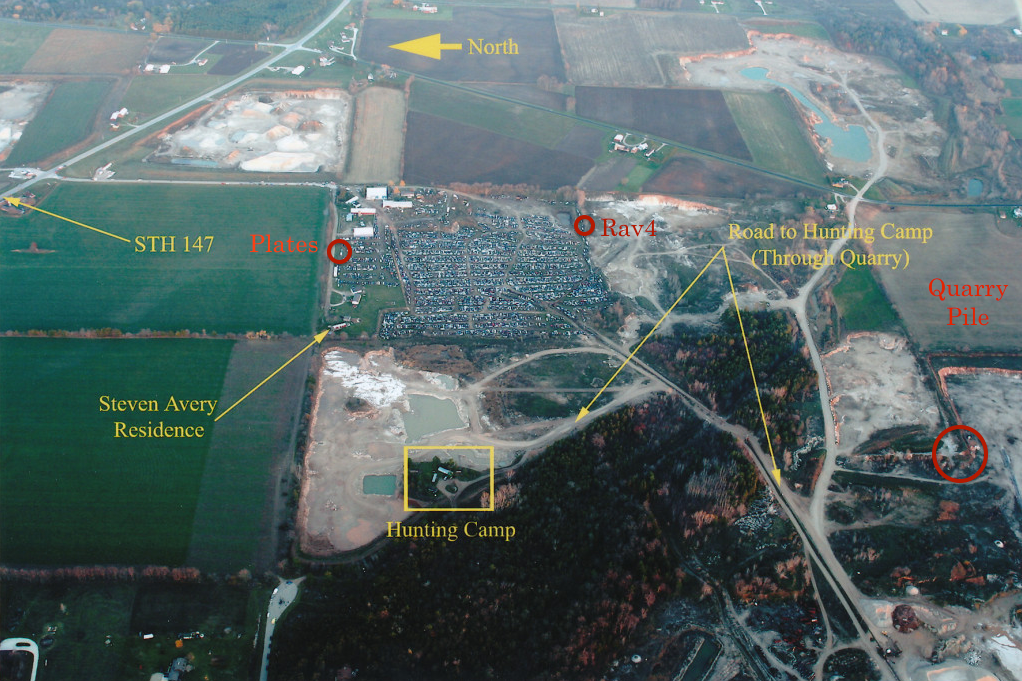

I was told by DOJ agents that they believed Teresa Halbach's vehicle was driven to the Kuss Road cul-de-sac by driving west through an empty field, then south down the gravel road past the hunting camp until reaching an intersection with a gravel road that ran northeast into the Avery property. They told me that they believed Halbach's vehicle turned northeast onto the gravel road and entered the Avery property at its southwest corner. It is my understanding that this theory was based on the work of scent tracking dogs. [Excerpt from Joshua Radandt's 2017 affidavit]
After the flyover ended around 6:00 p.m. on November 4, the killer drove Ms. Halbach's vehicle to the southeast corner of the Avery property.
The killer parked the RAV-4 in the southeast corner of the Avery property on a ridge overlooking a pond. The killer parked the RAV-4 facing west, although the vehicles surrounding the RAV-4 all faced east, and tried to conceal the RAV-4 using tree branches, cardboard boxes, and a rusty car hood as an explanation for why the car was not seen in the flyover video. (Mr. Kratz admitted that the RAV-4 was not visible in footage taken during the November 4, 2005 aerial surveillance.)
The killer, who drove the RAV-4 into the Radandt Pit in the late afternoon of November 4, was aided by an accomplice who drove another vehicle into the Radandt Pit to give the killer a ride out after the killer planted Ms. Halbach's vehicle on the Avery property.

Google Maps captured an image in September 2009 of a 1999 Isuzu Rodeo in Andy Colborn's driveway. In 2005, in was not uncommon for Wisconsinites to refer to SUVs as "jeeps" or "trucks."
A new witness describes seeing a vehicle similar to Ms. Halbach's RAV-4, followed by a white jeep, enter the Radandt Pit from Jambo Creek Road using an access road immediately south of his house. Only the white jeep returned.
Wilmer Siebert, ("Mr. Siebert") observed a vehicle similar in color, size, and style to Ms. Halbach's RAV-4 enter the Radandt Pit using an access road immediately south of his house. Mr. Siebert's house is immediately north of the east entrance to the Radandt Pit off of Jambo Creek Road. After observing the vehicle enter the Radandt Pit, Mr. Siebert saw pictures of Ms. Halbach's vehicle on the news. Mr. Siebert remembers the vehicle he saw driving into the

Colborn testified that he was not scheduled to work on November 4th-6th, 2005: that these were the three days he was scheduled to be off ("he worked a six day on, three day off rotation," noon to 8:00 PM shift, and he was scheduled to be off November 4-6th).
On January 11th, 2007, Colborn was interviewed by CASO's Steier, who asked Colborn if he could recall what he had done on Friday, November 4th, one of his scheduled days off. Colborn told Steier he could not recall what he had done on the 4th.
Colborn feigned ignorance about what he did on November 4th because he didn't want it to be public record that he worked overtime on November 4th to assist with the Teresa Halbach missing person's case, just as he worked overtime on Saturday, November 5th and Sunday, November 6th..
The following is part of Colborn's testimony at Avery's trial:
Q. Sergeant, you hold the rank of sergeant?Mr. Avery's brother Chuck told police that on November 4 he saw unidentified headlights in the salvage yard that evening. At 7:20 p.m. on
A. Yes, sir.
Q. And in early November of 2005, did you hold that same rank?
A. Yes, sir.
Q. What were your duties back in early November of '05?
A. Essentially the same duties that I hold today. I was a patrol supervisor on -- I work a six day on, three day off rotation. So on the days that the lieutenant that's assigned to the shift is off, I would be the shift commander.
Q. So you have supervisory responsibilities as well?
A. Yes, sir.
Q. I'm going to direct your attention to November 3rd of 2005, ask if you were employed on that evening?
A. Yes, sir.
Q. Do you recall what your duties were on November 3rd?
A. I was the shift commander for the noon to 8 shift, that's the shift I'm assigned to.
Q. Sometime during that shift, Sergeant Colborn, were you informed of a Calumet County missing persons investigation that was ongoing?
A. Yes, sir.
Q. And being involved in that -- or excuse me, being aware of that investigation, were you asked to assist in any way?
A. Yes, sir.
[...]
Q. Did you do anything on the 3rd of November to further investigate Mr. Avery?
A. On November 3rd?
Q. Yes.
A. No, sir.
Q. Did you ever go back onto his property on the 3rd?
A. No, sir.
[...]
Q. After going to the Zipperers with Detective -- I think it was Remiker and Dedering, what did you do after that?
A. After we were done, completed at the Zipperers?
Q. Yes.
A. I went home. I was done with -- you know, I was already on overtime. I checked out and went home.
Q. Do you know about what time that was?
A. 10:30, 11:00 at night, maybe.
Q. All right. Do you remember what you did the rest of that evening?
A. Just probably fell asleep on the couch. I went to bed and, you know, fell asleep.
Q. The next day, on the forth of November, were you working that day?
A. No, sir, I was off that day.
Q. It's a Friday; is that right?
A. Yes, sir.
Q. Do you remember what you did on the 4th? We'll get back to that, but do you recall, generally, your day on the 4th of November?
A. Yes, sir.
Q. Move your attention one day further, on the 5th, Saturday, the 5th of November; do you recall what you were doing that day or that morning?
A. That was also a regularly scheduled day off for me. Yes, I recall what I did on that day.
Q. We'll get into the morning, but let me just jump right to this investigation.Were you contacted at all by any supervisors or superiors that day and asked to participate in this case?
A. I was contacted by the noon to 8 shift commander for that day, and he did ask me to come into work and pick up a patrol vehicle and respond out to the Avery Salvage Yard.
Q. Did you do that?
A. Yes.
Q. In a marked vehicle?
A. Yes, I did take a marked vehicle out there.
Q. And about what time was it that you arrived at the Avery scene itself; do you recall?
A. I know I left my house between 4:00 and 4:30. I probably got out to the Avery Salvage Yard between 5:15, 5:30 maybe.
Q. To your best recollection?
A. Yes.
[...]
Q. The next day, that is, on the 6th of November, were you asked to come back to the scene?
A. Yes, sir.
Q. And what were you asked to do on the 6th?
A. On the 6th, when I came out there, again, with Detective Remiker and Lieutenant Lenk and I believe just -- this time just Lieutenant Lenk went into the Command Post to make contact with who we would be working with with Cal County that day. And Detective Remiker and I just kind of waited until he came back out. And we were introduced to Deputy Kucharski. And then Deputy Kucharski informed us what our assignment would be for that day.
The headlights were from Sgt. Colborn's personal vehicle, and he had a friend of Ms. Halbach with him to search the Avery property without a search warrant because he did not have probable cause to be on the Avery property at that point in time.
Sgt. Colborn, without probable cause for a search warrant for the Avery property, unwittingly relied upon the killer, a civilian, to find Ms. Halbach's vehicle on the Avery property.
On November 4, 2005, Sgt. Colborn discovered Ms. Halbach's vehicle and called dispatch, on a personal line, to confirm Ms. Halbach's license plate number. Audible in a recording of Sgt. Colborn's call to Manitowoc dispatch regarding the victim's plate number, a third party states, "it's hers."

The killer led law enforcement to Ms. Halbach's vehicle later in the evening on November 4. The killer represented to law enforcement that he would be willing to search the Avery property, something that the police could only do with a warrant based on probable cause, which they did not have on November 4. The killer, accompanied by law enforcement, went to the Avery property, and the killer proceeded to Ms. Halbach's vehicle in the southeast corner of the salvage yard. When the killer looked into Ms. Halbach's vehicle, he called out," it's hers," because he recognized her personal items in the vehicle, in addition to her vehicle itself.
The individual who helped Sgt. Colborn to the RAV-4 on the Avery property was most likely the killer because he was able to enter the Avery property and quickly locate the vehicle in the dark or with limited lighting. His words, "it's hers," shouted out when he looked in the vehicle and clearly recognized her personal effects, established that he was a close friend of Ms. Halbach. Sgt. Colborn called MCSD dispatch to confirm Ms. Halbach's license plate number. The dispatcher who answered Sgt. Colborn's call usually worked from 2:00-10:00 p.m.
Sgt. Colborn confirmed the identity of Ms. Halbach's vehicle by calling MCSD dispatch on his cell phone around 7:30 p.m. on November 4. Sgt. Colborn was with Mr. Hillegas, who led him to Ms. Halbach's vehicle, which had been previously planted by Mr. Hillegas on the afternoon of November 4, 2005, after a failed attempt to plant it closer to Mr. Avery's residence on November 3, 2005. Realizing such a call would be recorded, Sgt. Colborn removed the license plates from Ms. Halbach's vehicle to conceal that he had actually located the vehicle at the point in time, when he made the call about the license plate.
Sgt. Colborn's dispatch call was produced to trial defense counsel among other calls recorded by Manitowoc County Sheriff's Department on a CD. The recordings, which are labeled "Track 1" through "Track 30," give no outward indication of when they were left. However, based upon a review of the content of the recordings, it is apparent that the recordings are organized chronologically on the CD.
Sgt. Colborn's dispatch call was titled "Track 3." The preceding recording, "Track 2," is a call to Manitowoc Dispatch from an unnamed officer regarding George Zipperer. The officer requested a criminal records check of George Zipperer from the dispatcher. It is reasonable to conclude that this call was placed by one of the MCSD officers who was with CCSD Det. Dedering before they proceeded to the Zipperers on November 3, 2005 [around 9:30 p.m.]. Therefore, it follows that Sgt. Colborn's call to dispatch occurred after he responded to the Avery property to make contact with Mr. Avery and after he drove back to the MCSD. Further, based upon the order with which Inv. Dedering organized his report, Sgt. Colborn's call to dispatch occurred after he (Sgt. Colborn) informed the officers assembled at the MCSD about his contact with Mr. Avery.
On the afternoon and evening of November 4, 2005 [from 4:15-7:25 p.m.], Mr. Hillegas received twenty-two phone calls from a number or numbers with no identifiers. It is reasonable to conclude that law enforcement officers were calling Mr. Hillegas in connection with conducting an illegal search of the Avery Salvage Yard, using Mr. Hillegas to access the property.
It is during this time period that Sgt. Colborn called dispatch to confirm the license plate on Ms. Halbach's car.
In his pre-trial hearing testimony, Mr. Hillegas stated that although he was not sure how many times he talked with Sheriff Pagel on November 4, 2005, they spoke at least once. Mr. Hillegas did not recall whether he had contact with Inv. Wiegert on November 4, 2005. [According to Wiegert, he first interviewed Hillegas at 10:08 a.m. on November 4.]
On November 5, 2005, with information obtained from law enforcement in twenty-two unrecorded calls on November 4, 2005, Mr. Hillegas directed Pam to search Avery's Auto Salvage. While Mr. Hillegas provided only maps and missing person posters to other citizen searchers, Mr. Hillegas provided Pam and her daughter Nikole, the only searchers allowed access to the Avery Salvage Yard, with a digital camera and Calumet County Sheriff Pagel's direct line.
Clearly, Mr. Hillegas knew that Pam would discover Ms. Halbach's vehicle. Pam located Ms. Halbach's vehicle on the Avery salvage yard -- among 4000 other vehicles on the forty acres of uneven topography -- within thirty minutes of her arrival, a true statistical improbability. It is clear that Pam was provided information pertaining to the location of Ms. Halbach's vehicle by Mr. Hillegas.


Once the vehicle was found on the Avery property, the investigation of any other potential suspects halted, and, just as the killer planned, the whole case was focused on Mr. Avery. The killer duped law enforcement into focusing exclusively on Mr. Avery and helped them justify planting additional evidence to frame Mr. Avery.
In addition to maintaining control over Ms. Halbach's home and possessions, Mr. Hillegas personally searched property surrounding the Avery Salvage Yard and entered the salvage yard on multiple occasions. Even after November 5, 2005, the police allowed Mr. Hillegas through checkpoints to come and search the area. On November 7, 2005, Mr. Hillegas accessed the Avery property from 9:03 a.m. to 9:53 a.m. Mr. Hillegas made a second entry to the Avery properly on November 7, 2005, exiting the property at 4:28 p.m. Suspiciously, Mr. Hillegas never logged into the property when he entered the second time, meaning there is no way to know when he arrived or how long he had access to the property. (On at least one occasion, Mr. Hillegas also accessed the Avery and surrounding properties using a fake name.)
This access to the salvage yard would give Mr. Hillegas opportunity to plant the bones of Mr. Halbach, and her electronic devices, on November 6 and 7, now that the investigation was already focused on Mr. Avery. This would also explain why, despite previous searches of the Avery and Janda burn barrels, bones were not discovered until November 8, 2005.

Ms. Halbach was at a higher risk for being a victim of violence because of her involvement in nude photography and her affair with a married man and with her ex-boyfriend's best friend.
Ms. Halbach's ex-boyfriend was verbally and physically abusive to her during their relationship;
Ms. Halbach's ex-boyfriend had sustained visible injuries to his hands, from fingernail scratches, around the time of her disappearance.
Ms. Halbach's ex-boyfriend initially gave the police a false name, minimized his relationship with her, lied about crime scene evidence, controlled and led the searchers to Ms. Halbach's vehicle, had unrestricted access to the Avery property to plant evidence, assisted law enforcement in locating her car, and was living in her house after her murder in complete control of the evidence, disseminated to law enforcement, from her personal papers and effects.
At first, Mr. Hillegas told law enforcement that he was just a friend of Ms. Halbach's. Despite authorities eventually learning that Mr. Hillegas was Ms. Halbach's ex-boyfriend, he testified that he was never treated like a suspect in any way.
Mr. Hillegas was trained as a nurse but was unemployed in October and November 2005. He had no alibi for October 31, 2005.
Mr. Hillegas was not asked to provide an alibi. When asked by police about his last interactions with Ms. Halbach, Mr. Hillegas testified that on October 30, 2005, he dropped something off for Ms. Halbach at her house. Suspiciously, Mr. Hillegas does not recall what he delivered to Ms. Halbach nor can he remember anything about what time of day it was when he went to Ms. Halbach's residence even though this was supposedly the last time when he saw Ms. Halbach alive.
He was not asked to explain his past relationship with Ms. Halbach or to provide an alibi for the afternoon and evening of October 31. He was not asked about the scratches on his left hand or why he knew Ms. Halbach's voicemail password.
The killer was not treated like a suspect. Mr. Avery would immediately become the only suspect.

Failure of Law Enforcement to Investigate Ms. Halbach's Background to Realize That She Was at an Elevated Risk of Becoming a Victim of Violence
[Ms.] Halbach, the victim in this case, could be considered to be at an elevated risk for becoming the victim of violence due to her prior abusive relationship with her ex- boyfriend, [Mr.] Hillegas, and her business, which involved nude photography. Third party advertisers began advertising Ms. Halbach's business as providing "adult entertainment services." Although there is no proof that Ms. Halbach herself chose to advertise her business as providing "adult entertainment services," her nude photography business led others to advertise her business as providing "adult entertainment services."
Failure of Law Enforcement to Identify Prior Abuse in Ms. Halbach's Romantic Relationships to Correctly Assess the Motive for Her Murder
Based upon violent crime statistics, the killer most likely knew Ms. Halbach and may have been involved, at some point in time, in a romantic relationship with her.
The relationship was characterized by verbal and physical abuse by the killer towards Ms. Halbach. Even after Ms. Halbach ended their relationship, the killer continued to attempt to exert control over her by living nearby and coming to her home frequently.
Before Ms. Halbach's murder, the killer most likely became aware that she was sexually involved with a married man [Brad Czech] and a second male [Scott Bloedorn], who was a very close friend of the killer's.
The Killer's Post-Mortem Activities to Conceal Evidence and Frame Mr. Avery
The killer wanted as much time as possible before the people close to Ms. Halbach realized she was gone. As she received more and more phone calls, her voice mailbox became full, something uncharacteristic of Ms. Halbach. The killer, who knew the password to her voice mailbox, deleted several of Ms. Halbach's voice messages to buy himself time before Teresa's family and friends realized that she was missing and began searching for her.
Before her death, Ms. Halbach was known to regularly check and respond to her voicemails. If family and friends were to call Ms. Halbach and receive a message that Ms. Halbach's voicemail was full, it can be assumed that they would have been alarmed. When Ms. Halbach's voicemail was discovered to be full on November 3, 2005, it triggered her friends and family to notify law enforcement that she was missing.
The killer deleted voice messages from Ms. Halbach's voicemail in order to prolong the window of time before Ms. Halbach was reported missing, thereby increasing the amount of time the killer had to dispose of Ms. Halbach's body and personal effects.
The method of deletion, in order to leave no record in Ms. Halbach's cell phone records, could only be accomplished in one way: her voicemail had to be accessed from another phone by using Ms. Halbach's voicemail password.
Ms. Halbach's phone records do not indicate that her voicemail was accessed using her own phone after 2:12 p.m. on October 31, 2005. This indisputable fact means the person who accessed Ms. Halbach's voicemail, prior to the authorities realizing she was missing on November 3, 2005, had to be the killer, who knew Ms. Halbach's password, which would be required to delete voicemails recorded to her phone.
The killer knew Ms. Halbach very well in order to know her password. Clearly this person was not Mr. Avery.
The killer wanted to control the investigation and direct it towards the single goal of framing Mr. Avery for the murder. To accomplish that goal, he volunteered to take control of the citizen search as a means of both staying informed and controlling the focus of the investigation.
In his initial contact with law enforcement, the killer immediately attempted to misdirect their investigation by not telling them about his relationship with Ms. Halbach or her relationship with other men.
The killer participated in the discovery of major pieces of evidence, even going as far as leading searchers to the vehicle that he planted.
The Killer, and Not Law Enforcement, Planted Mr. Avery's Blood in the RAV-4
Current post-conviction counsel's blood spatter expert has demonstrated that Mr. Avery's blood was planted in Ms. Halbach's RAV-4. The only parties who may have had motive to plant evidence inculpating Mr. Avery were the killer and law enforcement, namely MCSD, in light of Mr. Avery's pending civil action against Manitowoc County.
- END EXCERPTS FROM POST-CONVICTION PETITION -

From Zellner's August 26, 2016 motion: "Individual B accessed the property using a false name ... Exhibit G."

Zellner Names Ryan Hillegas as Prime Suspect and Says Jealousy was His Motive
Zellner told USA TODAY NETWORK on June 12, 2017 she is not obligated by the criminal justice system "to prove Ryan Hillegas murdered Teresa Halbach" to get Steven Avery's conviction vacated.
"Rather, we are trying to show Hillegas had motive, opportunity and a connection to the crime that meets the Denny (third-party suspect) standard. The jury should have been presented with this evidence. It may have created a reasonable doubt about Steven's guilt."

