UPDATE AUGUST 22, 2019 (VIDEO ABOVE OF CASO DISPATCH CALLS)
Lenk and Colborn, as well as others, are by the red trailer at Josh Radandt's deer camp on November 7, 2005: "Is there anyone available to bring us down a roll of barrier tape needed down by the red trailer? We're gonna need an investigator to take a look at something. We've got a burning barrel just off the property. In the debris is a cell phone. Go just down the lane where the trailers are, that's where we are, west of the command post (on Avery Road)."
The image above is from November 8th, the day bones were found in or near Avery's fire pit. There are tire tracks from the field road to the fire
pit. The field road connects the Avery property to the cul-de-sac on Kuss Road and the driveway to Radandt's deer camp and his quarry.
The image above is from a flyover on the morning of November 4th by NBC26: there aren't any tire tracks from the field road to Avery's fire pit.
Bone fragments could not have actually been located in burn
barrel no. two because this barrel had already been sifted by WSCL
personnel on November 7, and no human bone fragments were discovered
in this barrel or any of the barrels examined at that time. During
their examination of barrel no. two on November 7, 2005, WSCL
personnel used the same sifting apparatus that they later used to sift
the burn pit behind Mr. Avery's garage. Suspiciously,
the pieces of burned bone that were eventually found in barrel no. two
were noticeably larger than the bone fragments from the burn pit. If
bone fragments had been in burn barrel no. two when it was
examined by Mr. Ertl and his team from the WSCL on November 7, 2005, the
bone fragments would have been isolated by their sifting apparatus.
ORIGINAL POST, PUBLISHED ON DECEMBER 14, 2016
The only barrels described as 55-gallon drums came from Radandt's deer camp. Three other barrels were described as "two metal barrels" and "a 50-gallon burn barrel" collected from Janda's backyard.
One of the three deer camp barrels, barrel #2, contained burnt bone fragments (CASO page 248).
Kratz swapped out one of Barb Janda's burn barrels and
replaced it with "deer camp
burn barrel #2." Or, if there were only three barrels, not four, as Bobby Dassey testified, Kratz shuffled the barrels by adding deer camp burn barrel #2 (or the contents there of) to the three barrels in Janda's backyard.
Kratz relabelled deer camp burn barrel #2 as Janda burn barrel #2 (he added a fourth barrel or he removed a barrel, returned a different barrel in its place, deer camp barrel #2, then recollected that substituted barrel and labelled it as Janda burn barrel #2).
When questioned at Avery's trial about cadaver dogs, Tom
Fassbender testified that on November 5th, 6th, and the 7th, during
evidence
collection, a dog did not alert on the the fire pit behind Mr. Avery's
garage, but a dog or dogs did alert on an area at or around the cul-de-sac on Kuss Road (GPS coordinates for this area are N44° 15.263 W87° 42.031, per CASO page 137).
At some point early in the investigation, "deer camp burn barrel #2"became "Janda burn barrel #2."
According to a friend of Joshua Radandt's who was at the deer camp between November 4-6, 2005, the woods and gravel pit at Radandt's quarry were searched the morning of November 5th, before Teresa's RAV4 was found at Avery Salvage Yard, but the deer camp wasn't searched prior to November 7th. They found human bones in and near Avery's fire pit (also referred to as a "burn pit") on the afternoon of November 8th (page 157).
"I was at the deer camp [at Radandt's quarry] when the car [Teresa's RAV4] was found about 300 yards away [on Saturday, November 5, 2005, by the pond in the "pit" of Avery Salvage Yard]. I didn't see anyone search the deer camp while I was there November 4-6th. They did walk through the woods and gravel pits that Saturday prior to finding the car. It [the deer camp] might have been searched by police between October 31st and when the car was found and after I was gone for the weekend. Don't remember. The reason Josh and Travis were on the sign up sheet that day [Saturday, November 5th] was because they were asked to give a statement regarding the fire. I have read about Josh being questioned at the deer camp, but it's not true. What some of you guys are missing since you haven't been to the deer camp is that the camp is at the same elevation as the Avery property where [Joshua claims] the fire was burning. The land between the deer camp and the fire is dug out. I could see Avery's shack/yard from the parking area of the deer camp. It isn't unreasonable to see a fire at dusk from that distance and sight line." - InTheKnow2016, August 30, 2016, Reddit
The following outlines how "deer camp burn barrel #2" became "Janda burn barrel #2."
The barrel with the tag in the photo above does not look like the other barrels, and it appears to have letters stamped on the side. This barrel is newer and in better condition than Avery's barrel and the Janda barrels in the photos below. Is this barrel from Radandt's deer camp? "On 11/12/05, Property Tag #7958, burnt material with the words deer
camp burn barrel printed on the container, was turned over to Riemer" (CASO page 248). Did Barb Janda have three or four barrels (pictured below)?
Above is evidence photo 52, the burn barrels from Barb Janda's backyard. There could have been only three, not four barrels.
Steven Avery told Detective O'Neill that Barb Janda had three or four barrels.
Barb Janda was interviewed on November 9, 2005, after Steven was arrested at his brother Earl's house in Whitelaw, WI. She was asked how many burn barrels she has in her back yard: she answered two or three (Barb also was asked how many burn barrels does Steve have, and she answered, "by the field is the only one I know of").
During direct examination, Bobby Dassey told Ken Kratz that there were three barrels (day 3, page 64), which should have been addressed by the defense but wasn't (Kratz simply responded, "Okay," and moved on):
Q. The next exhibit is Exhibit 52. Telt us what that is please?
A. That would be a picture of our burning barrels.
Q. What do you mean "our burning barrels'?
A. My mom's burning barrels.
Q. How many were there?
A. Three.
Q. Are you sure?
A. I don't know. I thought there was three.
Q. Okay. Where were the burn barrel's located?
A. In our back yard, right behind our garage
On Blaine Dassey's map, it shows there were may have been three, not four barrels (Skorlinski wrote a report on his and Wendy Baldwins's contact with Blaine at Cedar Ridge Restaurant in Maribel on November 5th; however, this report was not entered into evidence at Avery's trial). The following map of the property must have been drawn by Blaine during his interview on November 5th, although it was included in the DCI report of his second interview on November 7th (and the date of the map was changed).
Burn barrel from Avery's front yard
To summarize:
On 11/11/05, DCI Agents Rindt and Pevytoe came to the Calumet County Sheriff's Department to go through five barrels.
On the same day, 11/11/05, Property Tag #7947, burnt material, was found south of Avery's fire pit.
On 11/12/05, Property Tag #7958, "burnt material with the words deer
camp burn barrel printed on the container," and Property Tag
#7963, "burnt material from the deer camp," were turned over to Riemer.
Three burn barrels that were taken from the deer camp were processed
on 11/12/05, per Pevytoe's testimony, direct exam, day 18, page 34.
On 11/12/05, Riemer, Pevytoe and Ebben processed item #643, along with #642, #644 and #645 (CASO, page 248). Items #642, 643 and 644 were 55-gallon barrels with miscellaneous items inside (the three deer camp burn barrels). When processing Item #643 they found various bone fragments.
Riemer wrote in the report that material in a burn barrel from
Radandt's deer camp included a burnt bone and possible tissue pieces.The burnt bone from the deer camp burn barrel was labelled Property Tag #7963, "burnt bone pieces from Barrel #2."
Riemer, in his 11/12/05 report, also referred to the deer camp burn barrel, Item #643, as burn barrel #2 (CASO page 248).
The burnt material found in the deer camp burn barrel was labelled with Property Tag Nos. 7958 and 7963.
However, Hawkins wrote that Remiker and Dedering found the bone fragments when they sifted Property Tag #7963 on 4/11/06. They
claim to have collected the bone fragments and labelled them Item #21,
Property Tag #7429, but this number is out of sequence and should have
been assigned earlier than #7963, which was processed on 11/12/05.The report below has Riemer listed as the author, but it appears to have been written first by Riemer and then added onto by Hawkins (pages 729-733).
We began again on 04/11/06 at 0829
hours. The personnel available on 04/11/06 were Deputy JEREMY HAWKINS of
the CALUMET COUNTY SHERIFF'S DEPARTMENT, Special Agent KEVIN HEIMERL,
Det. DAVE REMIKER of the MANITOWOC COUNTY CALUMET COUNTY SHERIFF'S
DEPARTMENT, Sgt. BILL TYSON, Inv. JOHN DEDERING and me (Deputy RIEMER)
of the CALUMET COUNTY SHERIFF'S DEPARTMENT.
At 1108 hours, Inv. DEDERING and Det. REMIKER began processing Item #7963.
At
1050 hours, Special Agent FASSBENDER checked out and checked in at 1117
hours along with Inv. DEDERING, Det. REMIKER and Inv. WIEGERT.
At 1157 hours, Item #7954 began to be processed by Det. REMIKER.
At 1157 hours, Item #7958 was processed by Deputy HAWKINS and me.
Item #21, Property Tag #7429, bone fragments from sifting of Item #7963, collected at 1140 hours on 04/11/06.
At
1157 hours, Deputy RIEMER and I processed Property Tag #7958, a five
gallon pail of debris. When the five gallon pail was finished being
sifted through, the contents were placed back into the five gallon pail
and then resealed.
At approximately 1230 hours, Deputy
RIEMER and Iprocessed Property Tag #8650, debris pile matter in a five
gallon pail.All possible bone fragments were taken out of the debris
pile and placed into a cardboard pill box. When the five gallon pail was
done being sifted through, the possible bones were packaged in the
cardboard pill box by Deputy RIEMER. The sifted material was placed back
into the five gallon pail where it was then secured.
Once all the pails were sifted through, Deputy RIEMER released the following items back to me:
Property Tag #643, a 55 gallon barrel with miscellaneous items inside
Property Tag #642, a 55 gallon barrel with miscellaneous items inside
Property Tag #644, a 55 gallon barrel with miscellaneous items inside
Property Tag #1102, a 50 gallon burn barrel, one-quarter full of material
Property Tag #7921, a metal barrel with burnt material
Property Tag #7922, a metal barrel with burnt material; the barrel has the number 4 on it
Property Tag #7923, a brown tarp with burnt material inside
Property Tag #8480, burn pile ash
Property Tag #8481, burn pile ash
Property Tag #7946, commingled metal, battery jumper, dog leash
Property Tag #7947, burnt material
Property Tag #7948, burnt material
Property Tag #7958, burnt material, deer camp burn barrel
Property Tag #7963, burnt material
Deputy RIEMER also turned custody of the following items over to me:
Property Tag #7429, bone fragments from Item #7963
THE BURN BARRELS AND AVERY'S FIRE PIT
Three 55-gallon burn barrels were collected from Radandt's deer camp, but there isn't a report by CASO or MTSO that explains when and how that happened.
One of the three deer camp barrels, barrel #2, contained burnt bone fragments (CASO page 248).
Barrel #2, the one with the bones that was collected from the deer camp, became "Janda's Burn Barrel #2."Kratz swapped and relabelled the barrels.
He crafted the false testimony. He even had hand signals for them on the stand.
Ken Kratz orchestrated the planting once the crime scene was moved to Avery Auto Salvage. The “evidence” reads like a trial checklist for the jury, with no real thought as to how it got there or whether it makes any sense. Kratz wasn’t expecting the eyes of the world on everything. He tried repeatedly to get Making A Murderer footage seized so it couldn’t be seen, and even now he keeps bleating about the documentary to keep everyone’s attention off of the illogical evidence and shoddy investigation. Kratz dotted every "i" crossed every t"" to ensure a conviction, even offering up an eyewitness to the crime; and if that meant sacrificing a mentally-challenged child like a lamb to the slaughter, so be it. He delighted in creating his masterpiece fantasy sex crime and basked in the limelight it provided him. Regardless of who killed Teresa Halbach or why, without a doubt that conviction was sealed and delivered by Kratz. The entire scenario was left for him to design as he wanted, calling the shots, not having the forethought to give a rats ass if the pieces wouldn’t fit together when put under the scrutiny, such as has been cast upon him and his poorly thought out, horribly unorganized story, because he never dreamed this case would be given a serious look, outside his safely guarded state-level court systems. How could county-level employees, such as a the sheriff’s office and a county district attorney, get away with this sham after the release of Making A Murderer? You have to look much higher as to who gave the green light for this travesty. [Source]
"What do you say to conspiracy theorists out there who think maybe you did it?," Jean Friedman asked former DA Ken Kratz about Teresa Halbach's murder. Kratz smiled and said. “That’s really entertaining, actually. Obviously just for their information, I have an alibi for the 31st of October.” Friedman commented that Kratz was blushing as he answered the question. “Well, that’s because it's such a funny question to answer.”
"Kratz letter: My client will never admit guilt but so appreciate you sending your DNA on envelope. #MakingAMurderer" - Kathleen Zellner, Twitter, January 23, 2016
"I am the most notable prosecutor in Wisconsin history because of the Steven Avery case." - Ken Kratz, May 2010 (page 19)
Ken Kratz wrote this about himself in the forward to his book:
In his 25-year prosecution career, Ken Kratz has handled many complex and high-profile cases including homicides, sexual assaults, child abuse cases, and property crimes. Widely considered one of the state’s best criminal trial attorneys, Ken dedicated his career to advancing the rights of crime victims, serving on the Attorney General’s Crime Victim’s Council, and as Chairman of Wisconsin’s Crime Victim’s Rights Board from 1997 to 2009. Ken also proudly served as President of the Wisconsin District Attorney’s Association in 1996. For his work on the Teresa Halbach homicide case, Ken was named “Prosecutor of the Year” by the Wisconsin Association of Homicide Investigators in 2008. Ken has also received recognition from the Wisconsin District Attorney’s Association, Wisconsin Department of Justice, and Wisconsin Judicial Council.
The story that Brendan Dassey told in his coerced confession is Kratz's perverted sexual fantasy. Between Ken Kratz and Steven Avery, the one most capable of abducting and raping Teresa Halbach is Kratz:
Kratz talked about how he was into bondage. Kratz said he ties woman up, they listen to him, and he is in control.
Kratz said women have to listen to him or he hits them.
Kratz told her, "I know everything about you; I can make trouble for you." She said she did not know what Kratz meant, but she did not want to take the chance. She thought he could make things up, and she had been guilty of things in the past. He told her that if she did not listen to him he could "get her jammed up." She said Kratz had such "seniority" over her and it was "really scary." Kratz wanted her to engage in bondage with him. She said he instructed her to give him a "blow job," and she did. She stated that the blow job happened on her couch, and she was bent over Kratz. She said that he held her hands behind her back. Kratz also "clamped her mouth shut to swallow" with his hands. She said that while Kratz was still at her apartment she went to the bathroom and puked. After he left, she "puked her brains out" and stayed in bed for about a week. She said she had been raped when she was 16, and she said "this feels a lot like it."
The title quote comes from a tweet by Ken Armstrong, which was retweeted by both Drizin and Zellner.
It highlights the case against Encarnacion Salas, in which the Washington Appeals Court just ruled to reverse his conviction and grant a new trial based in part from "prosecutorial misconduct in the use of PowerPoint slides."
A supplementary article about this prosecutorial tactic can be read at The Marshall Project.
You can read about the various dirty ways the prosecution used PowerPoint tactics to subconsciously imply guilt in the order, starting on page 3.
While the magnitude of PowerPoint influence and prosecutorial misconduct varies by case, I was reminded of some ways PowerPoint was used by Kratz and company in the Avery case.
Avery's case opened with Kratz blatantly lying to the jury, by showing a slide with a circle and arrow pointing to a dot on the tailgate. He suggested that was Avery's blood alongside with Teresa's from his actively bleeding finger, after tossing her bloody body into the back of the RAV4. When the slide was shown with the arrow pointing to a dot on the tailgate, Kratz remarked:
The rear tailgate, remember I told you there was a droplet of Teresa's blood; because Mr. Avery is actively bleeding, there is a droplet of his blood as well.
Despite Kratz and the state knowing the ins-and-outs of the lab results and investigation for 1.5 years, he still consciously worked a major falsehood into a PowerPoint slide to present to the jury. There was no mixture of blood found of Avery and Teresa in the reports. There is no evidence that Avery was ever bleeding over the tailgate, nor any evidence that he was actively bleeding from his finger when allegedly fighting with Teresa given the lack of blood mixture anywhere.
There was also Austin's Forensic Mapping PowerPoint, created "under the direction of Mr. Kratz" that provided incredibly amateur and incomplete CGI scene "reconstructions." He utilized consumer 3D modeling tools like Rhino3Dto construct crude and poor-lit scenes that only tangibly resembled anything like the actual areas. Many details were missing from each modeled scene, and he seemingly improvised with the materials as he went along. In the Dassey case, he presented a new arrangement of the bedroom that absolutely did not match anything like how Brendan drew it. He later admitted it was not based on any one depiction, but rather creatively constructed to fit the state's theory and Brendan's tall tale (and based more on Jodi's recollection, which was months obsolete).
The EDTA PowerPoint presentation also included cheesy finger bleeding animations with big pools of blood to at least sub-consciously remind the jurors of the state's theory that Avery was actively bleeding from his finger all over the car (despite only a few tiny drops being founds in a very particular location, nowhere else and not mixed into Teresa's).
[–]MnAtty
I've been really surprised how much visual aids have insinuated their way into the courtroom. I'm glad you brought this up, because it's been nagging at me quite a while.
Kratz went beyond including visual aids—he was very slick about substituting visual aids for actual evidence. I saw several instances where he was pushing the envelope, to the point that I suspected he was knowingly tricking juries (and apparently, opposing counsels and judges as well) by using inauthentic visual aids deceptively.
Visual aids are not evidence. I'm guessing though, that both sides have learned to take advantage of today's computer/printer technology, to produce attention-getting visual aids as part of presenting their case.
However, litigators are going to have to start paying much closer attention to these exhibits. It should be a straightforward objection, but it means careful scrutiny is going to be required when such exhibits are offered into evidence.
Here's a good article discussing the admissibility of visual aids:
I believe anything is possible. I am wide open to any and all ideas.
At the risk of everyone here wanting to put me in a rubber room with a straight jacket........
I've always believed Timothy P. Austin had an alternative purpose for the State. His official purpose was to "map" the Avery property with animations (cartoons).
My pessimistic and skeptical thinking leads me to believe he was used to help edit audio/video possibly photo records. The rest was smoke and mirrors. I hope you take the time to read his CV and crappy PowerPoint presentation.
To believe in Steven Avery’s innocence is to believe that
someone must have planted evidence to frame Steven Avery. There is no
way around this as Avery’s blood is in Teresa’s Toyota RAV4, to say nothing
of the key, the bullet or the bones in the backyard fire pit could not
be plausibly explained any other way. The usual suspects, so far, have
been Colborn and Lenk, and really all of law enforcement in that area,
but as I have made clear, I have reason to believe that there is plenty
of reason to doubt their involvement as Ken Kratz is a far more likely
suspect as the chief, if not the sole, depositor of false evidence.
There is this thing I read about awhile ago called theory of mind
(ToM) which, so far as I can tell, boils down to a formal way of
describing the ability to get inside someone’s head. It can be useful
too, especially in sorting out what might have motivated a person’s
behavior.
[...]
Kratz is a compulsive, pathological
liar as has been fairly well established. I would point out that there
is something about the pattern of the supposed “evidence” against
Steven Avery which, in its sheer volume and variety, bears the tell tale
signature of his lies. If we know Kratz to be a liar, and there can be
zero doubt about that, what is the one thing that would propel someone
accustomed to performing relatively trivial acts of wickedness into
crossing a certain mental threshold whereby more consequential and
daring acts of turpitude would be attempted?
A high risk tolerance.
Some people are risk averse, while others seek
their thrills. So, where, might we surmise, does Ken Kratz fall on
this scale? I would argue, and adduce evidence, even, that Ken Kratz
has shown, even in his own words, that his tolerance for risk is very
high; and in light of this personality trait, I think my argument that
Kratz is the likely depositor of false evidence is further bolstered.
Consider, then, Kratz in the words that he sent Stephanie van Groll, a
woman who had sought the services of his office after she found herself
the victim of domestic abuse at the hands of her boyfriend:
‘Are you the kind of girl that likes secret contact with an older married elected DA … the riskier the better?’
The riskier the better. Of course, I don’t know what risk there
might have been for Ms Van Groll to have a sexual liaison with Ken
Kratz, but there was clearly a lot of risk for Kratz, and we know this
because it had been exactly these sort of unwelcome texts, along with even more outrageous and immoral acts, that caused Kratz to lose just
about everything he had: his job, his house, his status, his
relationships, and possibly much else. For a person in his position to
send out even a single text of this sort was to court utter ruin.
So, if, by now, I have convinced you that Kratz was capable of
depositing false evidence, the next question is whether Ken Kratz would
have colluded with anyone else? Well, why would he have needed to? We
have to assume he had unrestricted access to the entire crime scene, and
that would have included Steven Avery’s trailer and garage (and the trailer used to transport the RAV4 to the crime lab and the crime lab itself). Even if
Kratz had been seen entering any corner of Avery’s property, be it
inside or outside, this would not have raised any eyebrows.
Couple this with the fact that Kratz worked out of Calumet County. As the District Attorney, he would have probably been the person in the
highest position of authority there, and therefore had unrestricted
access, night and day, to the areas where evidence in pending cases was
stored. That means he would have had access to Steven’s gun, to
Steven’s DNA, to pretty much the whole megillah, as they say.
The timing of the discovery of the evidence also comes into play. If
it had all been there all along, you would expect the discovery of one
piece or the other to be staggered. Maybe the bones on day two, maybe
the bullet on day nine, the key at some other random time. But if the
evidence was planted more or less at once, then one would expect the
discovery of the evidence to happen all at once, and that’s exactly how
it happened.
Kratz, in a stroke of sheer, multifaceted, mastermind, criminal
brilliance, knew that others would find the evidence that he left
behind. He could then just sit on the sidelines while they took the
blame, while at the same time confidently, and, as it turns out,
accurately claiming that the theory of a conspiracy on the part of law
enforcement was patently absurd.
He could fool all of law enforcement while at the same time doing
them all great harm by bringing literally global scorn upon them. He
could fool all of those who believe in Avery’s innocence by erroneously
getting them to think Lenk and Colborn played a role (and do a great
deal to ruin their lives, as well). And on and on.
As I sit here and write this, I fear that I will convince no one and
probably alienate a lot of people, maybe everyone. Almost everyone who
believes in Steven Avery’s innocence believes Manitowoc County
Sheriff’s Office had a hand in framing Steven Avery. But I am not of
the constitution to be able to play to an audience, even if that
audience agrees with me, and even if we might get along swell if I
pretend to agree with them. I don’t expect anyone in Manitowoc,
Wisconsin, much less in the sheriff’s department there, to read this and
find any of it persuasive. But it’s what makes sense to me, and and
owing to some constitutional infirmity, I go, unswervingly, wherever my
powers of ratiocination guide me.
If Ken Kratz planted one piece of evidence, he planted all of it: the
bones, the melted phone and camera, the blood, the “hood latch” DNA,
the key, and the bullet.What we’re left with is a Toyota RAV4 in the
remotest corner of a salvage yard on the edge of town and really not
much else, except for Teresa’s appointments that day and the murky
circumstances surrounding the visit she was paid by her ex-boyfriend the
day before.
danielrluke wrote on February 22, 2017:
I have listened to the audio of Colborn calling in the plates, but I
cannot rule out that he had simply called in to confirm what was on the
flyer that was widely distributed in the community that had the license
plate and vehicle description printed on it. And because I cannot rule
that out, I have to default to the simpler explanation of the two, as the simpler explanation is usually the correct one (Occam’s Razor). It is also much easier for me to accept one, rather than multiple planters of evidence for the same reason.
A facile explanation would be that all of law enforcement in the area
was corrupt, and to leave it at that without providing further detail, but
if we implicate Kratz, a person who probably didn’t even know either
Lenk or Colborn, we are forced to explain why one or the other would
have risked involving the other in highly risky, nefarious deeds.
Kratz
is the seeker of glory here. He is the one who had the most to gain by
successfully prosecuting Steven Avery. Kratz is the one with the chequered past, and a string of highly questionable deeds.Both
Lenk and Colborn have always struck me as milquetoasts, Mayberry-esque
kind of. That impression could well be wrong, but no one has ever come
forward to ever describe them as doing anything remotely like the sort
of stuff we know Kratz has done and continues to do.
And I would return
to this: if
Kratz had all of the evidence in his possession, and he had
unrestricted access to it, and he had as much time with it alone as he
desired, why is it necessary to involve Colborn and Lenk? I’m
not saying that I’m right, but I think about this matter a lot, and
this is the only scenario that I’m satisfied with. It is the only one
that allows me to put all of the pieces together. I
have scratched my head about all of this for a long time, and it’s only
when I put Kratz squarely in the center of it as the grand puppet
master does it fall into place. I think the reason people have trouble seeing it, including myself, owes to the sheer audacity of it all. But speaking even to this point, Kratz’s behavior continues to be audacious. He is an audacious man who does audacious things.
Ken Kratz, Crime Watch Daily, March 3, 2017, on the letter from jailhouse snitch Joseph W. Evans Jr., who claims Avery confessed to him:
Kratz: There's many parts of Mr. Evans letter that are plausible.
Kratz: I don't know if it's authentic or not.
Kratz: It may or may not be believed, [it depends] on all those other circumstances. I don't know, I don't know.
Host: You have to have an opinion on this, Ken.
Kratz: And, if I did, I wouldn't share it with you because it isn't a rabbit hole that I would really want it to go down.
Kratz: The main actor clearly is Steven Avery, it's
not Brendan Dassey. Brendan Dassey, in my opinion, never would've raped
or killed Teresa Halbach without the involvement with Steven Avery.
Host: Could this letter in some way affect Brendan Dassey's appeal?
Kratz: Probably not the appeal. Unless there is a
piece of physical evidence. His appeal is going to rise or fall on
whether or not that confession is going to be upheld by the federal
court.
Host: Is it possible that there is some new information in this inmate informant letter that's been made public?
Kratz: Absolutely. We didn't find a knife or any
other cutting instrument that at least Brendan said was involved. I've
got a sneaky suspicion though that law enforcement will be looking into
the new allegations that are made in that letter.
"The prosecutor has more control over life, liberty, and reputation than any other person in America. His discretion is tremendous.... While the prosecutor at his best is one of the most beneficent forces in our society, when he acts from malice or other base motives, he is one of the worst." - Former U.S. Attorney General Robert Jackson
Kratz groomed a snitch from inside and Zellner found out about it
before the snitch came forward to "unburden himself of Steven's homicidal
tendencies":
There
is a new development in the Steven Avery murder case that may contrast
with his post-conviction lawyer’s attempt to free him.
In
a 2016 letter obtained by Rockford Advocate, a man who befriended Avery
in prison says the “Making a Murderer” subject confessed to him how he
raped and killed Teresa Halbach on Halloween 2005.
Joseph
Evans Jr., a man convicted of killing his wife in 2009, says he met
Avery in 2010 at the Wisconsin Secure Program Facility in Boscobel,
Wisconsin. He recognized Avery from news coverage of Halbach’s murder,
and Avery knew of Evans’ Marinette County case.
After
small talk about their respective cases, Evans said Avery unfolded a
chilling, detailed confession that started with the contention that he
would have gotten away with murder had Brendan Dassey not talked to
police. Avery then walked Evans through how he lured Halbach into his
trailer, raped and strangled her, and continued to have sex with her
after she was dead.
“Steven Avery told me that he had
seen Teresa out at the salvage yard before,” Evans wrote in the
nine-page letter. “He said that he had thought that Teresa would be an
easy lay because he didn’t think she was all that pretty or anything.
…but she did have a sexy bottom on her.”
Evans said
when Halbach arrived at the salvage yard, Avery was being flirtatious
and asked her to dinner. Teresa refused the date, but agreed to go
inside Avery’s trailer to talk about about the sale of the vehicle she
came to photograph. After talking with Halbach at his kitchen table,
Avery grabbed a knife from a drawer and Halbach by the back of the hair,
Evans said.
“He said he put the knife to Teresa’s
throat as he guided her to his bedroom,” the letter continues. “Steven
said Teresa was crying and begging him not to kill her.”
Similar
to the prosecution’s theory gleaned from Dassey’s now thrown-out
confession, Avery tied Halbach to his bed, only he used one of his
shirts and pair of his socks, Evans said, not the leg and arm irons
found by police.
For approximately 90 minutes, Avery
raped, strangled and sodomized the 25-year-old freelancer, stopping
periodically to choke her to make sure she wasn’t breathing.
Enter Brendan Dassey.
With
the freshly killed Teresa Halbach in his bed, Avery cleaned himself up,
knowing he called his nephew over to “give him a hand.”
“Steven
had said that Brendan had asked him, ‘Why is she just laying there like
that,’ (and) Brendan thought she was just sleeping,” Evans said.
Avery
then gave his nephew permission to have sex with Halbach, but said to
“hurry up because they had to get rid of her.” The teen obliged, later
asking if she was a heavy sleeper because she never moved. That’s when
Evans said Avery laughed at his nephew “for being so stupid,” before
telling the boy Teresa was dead. To make sure, Avery cut her throat but
did not believe the wound was very deep, given the lack of blood.
“Steve
said that after he had Brendan help him tie Teresa up with rope and
taped her mouth shut, they carried her body into the kitchen.”
Avery
moved Halbach’s Toyota RAV4 closer to the trailer, and Dassey placed
her body in the back of the vehicle. They pulled the SUV into Avery’s
garage and placed her on the floor, Evans said. That’s when Avery
grabbed a .22-caliber rifle and shot her: twice in the head, twice in
the chest and once in the vagina.
“Then he had Brendan help him put Teresa’s body back inside of the Toyota, and drove it to his burning pit.”
While
Dassey covered Halbach’s body with old tires, branches and debris,
Avery got busy hiding the RAV4. He disconnected the battery and GPS
wiring and removed the license plates, Evans said. He put the Toyota’s
key in his front shirt pocket. He placed her phone, handheld computer
and camera on the ground and covered the RAV4 with boards so it would
blend in with other cars in the yard, Evans said.
“Steven
then stated that after he was done covering up the vehicle, he had
gathered up the items that he had placed on the ground and took them
back by the burning pit and tossed them into it.”
With
Teresa’s body in the bottom of the pit, Dassey and Avery wiped the
trailer and garage clean using bleach and Gojo soap. Avery put
Halbach’s clothes, bedding, rags and a throw rug in garbage bags and
transported them to the burn pit in his car. There, they became part of
the gas- and oil-fueled bonfire, Evans said.
The key
While
millions of Internet sleuths claim Manitowoc County deputies had time,
opportunity and motive to plant the Toyota key, Evans said it ended up
in Steven’s bedroom because Avery mistakenly dropped it there.
“Steve
said when he was in his bedroom, he had taken off his flannel shirt and
tossed it up on the dresser, that’s when the key to Teresa’s Toyota
must had (sic) fallen out of his shirt pocket and fell between the
dresser and the bed.”
Burn barrel items and a vow of silence
After
tending the fire with Dassey for about an hour and a half, Avery
promised the teen he would buy him any car he wanted with proceeds of
the lawsuit he had pending against Manitowoc County. All Brendan had to
do was keep quiet, Evans said.
“Steve said that he told
Brendan that if he said anything to anyone he wouldn’t get anything and
that the two of them would both go to prison. Steve said that Brendan
promised to remain quiet and keep his mouth shut to everyone, then
Brendan left to go home.”
Avery tended to the fire, Evans said.
“He
remained out there by the fire for a few more hours and as it was dying
down, he could see some of Teresa’s bones and some other items that had
not burned completely, so Steve said he had taken a shovel and broke up
the bones and scattered them around, then he shoveled the bones and
other things into the burning barrel.”
Evans said Avery
discarded the shovel, knife, Teresa’s jewelry and some of his clothes
near Crivitz, Wisconsin, where Steven was when police discovered the
RAV4 and Halbach’s bones.
A parting promise
In
March 2014, Evans and Avery were transferred to the Waupun Correctional
Institution. By then, Evans said the deal between “Making a Murderer”
filmmakers and Netflix was in the works, and Avery had been advised to
stop talking about his case. He said because they were friends, Avery
promised to pay his restitution after he won a multi-million-dollar
lawsuit he planned to bring against the State of Wisconsin and Manitowoc
County.
Evans told Avery he needed to turn to God and admit to Halbach’s murder, if only to help Dassey, but Avery refused.
“‘Your (sic) f–king crazy,’ that kid is on his own, he shouldn’t had (sic) spoken to the police.”
Evans said Avery initially planned to pin the the murder on his brother.
Advanced forensic testing
Famed
post-conviction attorney Kathleen Zellner is still waiting for results
of forensic testing that began last year on several pieces of evidence.
She claims she has proof that Manitowoc County deputies planted evidence
in the case.
Evidence subject to forensic testing are:
A
vial of blood Avery’s blood drawn in 1996 and filed with the Manitowoc
County Sheriff’s Department. It is the vial attorneys Jerry Buting and
Dean Strang claimed may have been the source of Avery’s blood found in
the RAV4. The blood was previously tested for a preservative and none
was found.
A DNA swab taken from the hood latch of the
RAV4. This is the swab prosecutors say contains Avery’s sweat DNA he
left when he touched the latch in the process of disconnecting the
Toyota’s battery. The hood latch was tested six months after the murder.
Blood recovered from the floor of the RAV4.
Blood from a CD case found in the vehicle.
Blood from fabric found on the RAV4 seats.
Blood
taken from the ignition area. Prosecutors maintain the blood came from a
cut on Avery’s hand. His attorneys say it may have been intentionally
smeared there.
Swab of blood taken from the rear passenger’s door.
Zellner
said she plans to name another suspect she believes killed Teresa
Halbach. The second season of “Making a Murderer” could be released this
year.
What deal could Evans strike with the disclosure of the conversation and the writing of the letter:
-Conjugal visits
-TV
-Rec time
-Commisary accounts
-Extra curricular programs and activities
-Cell upgrades
-Institution transfers
There
are all kinds of perks a prisoner can negotiate to make life on the
inside a little more pleasant. But you need leverage. Leverage is huge
in prison.
I TOLD YOU KEN KRAITZ WOULD MENTION AND TRY TO LINK UP WITH THE INMATE CONFESSION LETTER IN HIS BOOK - BEWARE! THEY'RE UP TO SOMETHING - READ ON!
The court of public opinion, Kathleen Zellner isn't really concerned with it – but to the opposition it may be eveything!
Something we need to realize...
Since Making A Murderer came out and all of the web sleuthing began, all of the countless hours of pouring over details, uncovering facts or inconsistencies, and theorizing in an attempt to discover the truth, those responsible have certainly not been resting on their laurels.
For as long as we’ve been trying to uncover the truth – they have been trying to figure out ways to keep us finding it. This goes up high into the State of Wisconsin’s judicial system and branches of their political structure, and there are potentially some very powerful people involved.
We are fighting for justice and for Steven Avery and Brendan Dassey’s freedom, but they are fighting for something far more important in their minds.
When the fallout from MaM was becoming evident, and Zellner came aboard, the state knew it was incumbent on them to do whatever it takes to not let this happen. We're not talking about the bumbling “cops on the ground” that were instrumental in making this happen in 2005. No, were talking about well educated, intelligent, powerful and connected people who have a vested interest in making sure this isn't successful.
IMO with so many aspects of this case handled in such a bumbling keystone cops kind of manner, I believe this leads us into a false sense of security and confidence. We know Zellner will bring it – and hope when she does it'll bring us the answers that we've been looking for.
BUT ARE WE UNDERESTIMATING THE OPPOSITION???
Because they have a plan...
THE PLAN
The plan is being executed in stages – the first stage:
After asking Fassbender about the last person to see Teresa Halbach alive being an obvious place to start, kRATz makes the exaggerated check-mark motion on his note pad. He did that sickening motion numerous times. It is a sign of utter arrogance. So infantile. Can you imagine his bullet list?
Ask Fassy super smart question.
Sweat.
Petty objection.
Sweat some more.
Send dickpic.
Sweat so much I feel drips tickle my crack as they run down my back.
Erection!
"The way I hear it, Kenny was indeed offering up his 'services' to a whole list of domestic abuse victims... pro boner... cost him a 4-month suspension, 20k, his marriage, his house, his reputation, and any semblance of integrity remaining in his horrific existence...he's THE PRIZE... LOL." [HuNuWutWen]
Click here for Associated Press reporter Ryan Foley's audio interview of Ken Kratz.
"I am the most notable prosecutor in Wisconsin history because of the Steven Avery case." - Ken Kratz, May 2010 (page 19)
"He [Ken Kratz] would remind me of who he was, how he had prosecuted the biggest case around here, and what a 'prize' he was." - Dawn King, September 24, 2010 (page 14)
A domestic violence victim who turned to Kratz’s office for help claims
that the DA sexually harassed her via numerous text messages, trying to
convince her to have an affair with him. One of his texts read,
in pertinent part:
“I’m the atty. I have the $350,000 house. I have the
6-figure career. You may be the tall, young, hot nymph, but I am the
prize!”
Domestic abuse victim Stephanie Van
Groll and Calumet County, Wisc. District Attorney Kenneth Kratz are seen
in file photos. Katz "sexted" Van Groll repeatedly while prosecuting
her alleged assailant, threatening to drop the case if she didn't engage
in a sexual relationship. (AP Photo)
By The Associated Press September 15, 2010
A prominent Wisconsin district attorney sent repeated text
messages trying to spark an affair with a domestic abuse victim while
he was prosecuting her ex-boyfriend, a police report shows.
The 26-year-old woman complained last year to police after receiving
30 texts from Calumet County District Attorney Kenneth Kratz in three
days, according to the report obtained by The Associated Press.
"Are you the kind of girl that likes secret contact with an older
married elected DA ... the riskier the better?" Kratz, 50, wrote in a
message to Stephanie Van Groll in October 2009. In another, he wrote: "I
would not expect you to be the other woman. I would want you to be so
hot and treat me so well that you'd be THE woman! R U that good?"
Kratz was prosecuting Van Groll's ex-boyfriend on charges he nearly
choked her to death last year. He also was veteran chair of the
Wisconsin Crime Victims' Rights Board, a quasi-judicial agency that can
reprimand judges, prosecutors and police officers who mistreat crime
victims.
In a combative interview in his office Wednesday, Kratz did not deny
sending the messages and expressed concern their publication would
unfairly embarrass him personally and professionally. He said the Office
of Lawyer Regulation had found he did not violate any rules governing
attorney misconduct. That office cannot comment on investigations.
"This is a non-news story," Kratz shouted. But he added, "I'm worried
about it because of my reputational interests. I'm worried about it
because of my 25 years as a prosecutor."
'Three days of hell'
Van Groll told police in Kaukauna, Wis., where she lived, that she
felt pressured to have a relationship with Kratz or he would drop the
charges against her ex-boyfriend.
Kratz then removed himself from that prosecution and the state
Department of Justice took over. He resigned from the crime victims
board, which he helped create, after more than a decade as chair. He and
his wife filed for divorce last December, although he said they were
separated when the messages were sent. Kratz has remained the top prosecutor based in Chilton, where he has
served since 1992 and earns a $105,000 salary. Kratz, a Republican, said
he intends to run for re-election in November 2012.
Stephanie Van Groll, a domestic abuse victim whose ex-boyfriend
Shannon Konitzer was charged with nearly choking her to death.
"Nothing really happened to him and I had three days of hell," Van
Groll said in a phone interview with the AP. "They gave him a slap on
the wrist and told him not to do it again. If it was anybody else that
did something like this, they'd lose their job."
Domestic violence experts called Kratz's text messages disturbing and
unethical for several reasons, including the power differential between
a prosecutor and a younger abuse victim.
"If what's being alleged is true, it's sad a prosecutor would use the
same sort of power and control over a woman who has already experienced
that in her personal life," said Patti Seger, executive director of the
Wisconsin Coalition Against Domestic Violence.
Kratz: 'I wrote the law'
Kratz may be best known for prosecuting Steven Avery in the 2005
killing of Teresa Halbach, a 25-year-old photographer. The case won
national attention because Avery had spent 18 years behind bars for a
rape he did not commit in a separate case before DNA evidence implicated
someone else. Kratz received glowing media attention and flirted with a
run for Congress in 2008.
Last year, around the time he was texting Van Groll, Kratz was back
in the spotlight for prosecuting a woman who worked with others to lure a
boyfriend to a hotel room and glued his penis to his stomach as revenge
for his cheating.
In the interview, Kratz said he was proud he helped achieve
legislation creating the first-of-its-kind crime victims' board and that
he had dedicated his career to their cause.
"I wrote the law on crime victims in Wisconsin," he said, pointing to
a picture of him with former Gov. Tommy Thompson signing that law.
"That's the irony here."
A spokeswoman said the board has not received a complaint about Kratz and is not investigating his conduct toward Van Groll.
Kratz cited an undisclosed conflict of interest in stepping away from
the abuse case after Van Groll reported the text messages, court
records show. An assistant state attorney general acted as special
prosecutor and won a conviction on one felony count of strangulation
against the man, Shannon Konitzer.
Van Groll said Kratz sent the first text minutes after she left his office, where he had interviewed her about the case.
He said it was nice talking and "you have such potential," signing
the message "KEN (your favorite DA)." Twenty minutes later, he added, "I
wish you weren't one of this office's clients. You'd be a cool person
to know!" But he quickly tried to start a relationship and told her to
keep quiet about the texts.
Van Groll at first was polite, saying Kratz was "a nice person" and
thanking him for praise. By the second day, she responded with answers
such as "dono" or "no." Kratz questioned whether her "low self-esteem"
was to blame for the lack of interest.
"I'm serious! I'm the atty. I have the $350,000 house. I have the
6-figure career. You may be the tall, young, hot nymph, but I am the
prize!" he texted.
Kratz told her the relationship would unfold slow enough for
"Shannon's case to get done." "Remember it would have to be special
enough to risk all," he wrote.
Van Groll said she went to police on the third day after the messages
started becoming "kind of vulgar." She provided copies of 30 messages
and her responses, which the department released in response to an AP
request.
"Stephanie feels afraid that if she doesn't do what he wants Kratz
will throw out her whole case," an officer who interviewed Van Groll
wrote.
The department referred the complaint to the state Division of
Criminal Investigation because it works with Kratz's office on
prosecutions. Van Groll, a college student and part-time preschool
teacher who has moved to Merrill, said she has been told Kratz won't be
charged because "they didn't think he did anything criminally wrong."
Kratz on Wednesday waved a copy of what he said was a report by legal
regulators that cleared him. He would not give a copy to AP, and
slammed the door to his office when the interview was over.
A former prosecutor who sent racy text messages
to a domestic abuse victim will not face criminal charges over
misconduct and sexual assault allegations levied by more than a dozen
women, the Wisconsin Justice Department announced Monday.
State investigators determined that former Calumet County District
Attorney Ken Kratz’s “conduct appears to fit the connotation of
‘misconduct’ and demonstrates inappropriate behavior but does not
satisfy the elements required to prosecute,” wrote Assistant Attorney
General Tom Storm.
Kratz’s attorney, Robert Bellin, said his office was investigating whether anyone lied in an effort to hurt Kratz.
“I think it’s obviously the right decision,” Bellin said of not
filing charges. “I don’t think we were that worried about it. We think
that there were statements from individuals who came forward who were
not completely truthful.”
Kratz resigned from his $105,000 per year position in October after
The Associated Press reported he had sent 30 text messages trying to
strike up an affair with a domestic abuse victim while he prosecuted her
ex-boyfriend on a strangulation charge. Kratz, who was 50 at the time,
called 26-year-old Stephanie Van Groll “a hot nymph” and asked if she
was “the kind of girl that likes secret contact with an older married
DA.”
Van Groll complained to police and Kratz was removed from her
ex-boyfriend’s case. The Justice Department investigated at the time but
decided not to file charges. Kratz was instead ordered to self-report
the text messages to the Office of Lawyer Regulation, a separate state
entity that reviews attorneys’ conduct. The office declined to
discipline Kratz, saying he hadn’t violated any rules.
Pressure mounted on Kratz to resign after Van Groll’s allegations
became public. Then-Gov. Jim Doyle began removal procedures and other
women came forward with accusations. The Justice Department and the
lawyer regulation office both reopened investigations.
The Justice Department on Monday released its case summary, which
said Van Groll was among a dozen or so women who complained about Kratz.
Two claimed they had sexual contact with Kratz, five alleged
misconduct in office, and one alleged Kratz improperly told her about a
search warrant. The remaining complaints didn’t include an identifiable
criminal offense, the report said.
Storm, who led the investigation, wrote that one of the alleged
sexual encounters occurred in 1999 and the statute of limitations had
expired. The other sexual contact complaint contained “insurmountable
proof problems,” Storm wrote, adding the woman wouldn’t be a credible
witness because she suffered from mental illness, had prior convictions
and consented to the contact.
As for misconduct in office, complaints included the messages Kratz
sent to Van Groll as well as accusations Kratz sought a personal
relationship with one woman in exchange for help in winning a
gubernatorial pardon and a relationship with another woman in exchange
for help writing a victim impact statement against her husband.
But investigators found Kratz technically didn’t fail or refuse to
perform his duties, didn’t exceed his authority and didn’t try to gain a
dishonest advantage.
A woman also alleged that while she was out to eat with Kratz, he was
on the phone with investigators discussing a search that was under way,
possibly in connection with a search warrant. Wisconsin law prohibits
premature disclosure of a search warrant’s existence. But the woman
couldn’t say that Kratz actually disclosed a warrant existed at any
time.
“There is no reasonable possibility that further investigation will
reveal evidence establishing the elements of a criminal offense,” Storm
wrote. “There are no further leads to pursue and the file should be
closed.”
Separately, Van Groll has filed a federal civil lawsuit accusing Kratz
of sexual harassment. Van Groll’s attorney,
Michael Fox, didn’t immediately return a message Monday.
Weeks after Calumet County District Attorney Kenneth Kratz was
caught sending sexually charged text messages to a crime victim, he
shared confidential details of a murder investigation with another
woman and invited her to wear high heels to the victim's autopsy,
according to a letter obtained Monday by the Wisconsin State
Journal.
In the letter sent to Gov. Jim Doyle on Friday, the woman called
for Kratz's removal from office and an investigation into why the
district attorney was not sanctioned for his improper attempts to
strike up a sexual relationship with Stephanie Van Groll, whose
ex-boyfriend Kratz was prosecuting on domestic abuse charges
The woman could not be reached for comment Monday. However,
Doyle spokesman Adam Collins released a copy of the letter to the
media Monday afternoon - with the woman's name blacked out -
shortly before Doyle announced he would seek to remove Kratz once
he receives a "verified" complaint from a taxpayer in Calumet
County. Van Groll lives in a different county.
Kratz, who has held his position for 18 years, has apologized
for sending the text messages and said he would seek therapy. He
began a medical leave on Monday, but his attorney has said he would
fight attempts to remove him from office.
Kratz was also pressured to resign from the Crime Victims Rights
Board, which he had chaired for 11 years, on Dec. 3 after Van Groll
called Kaukauna police to report that Kratz had been harassing her
by sending 30 text messages in three days.
Last week, another woman wrote to Doyle's office to say she had
had a similar experience with Kratz, 50, after the two met on the
online dating service Match.com in December.
"We exchanged a few emails and eventually agreed to meet for
dinner," she wrote. "I was hesitant since he had written some
things that were inappropriate to say to someone at that stage of
communicating, and also seems to vacillate between kind and
interesting and insecure, impatient and demanding. But I figured
that as a public figure in a position of authority, I should be
safe with him."
Later in the letter, the woman recounts incidents that appear to
match the circumstances surrounding the case of Michelle Jaeger, a
39-year-old Chilton woman who disappeared in early January. Her
body was found on Jan. 24, and Manitowoc County District Attorney
Mark Rohrer has charged her former boyfriend, Roger D. Rosenthal,
with first-degree intentional homicide. Jaeger's body was found
near Brillion in Manitowoc County.
"We met for dinner at a restaurant in Green Bay on January 23,
2010," the woman wrote. "During dinner he was interrupted several
times by phone calls from Detectives who were investigating a case
of a missing woman who was suspected of having been killed by her
boyfriend.
"I told him that if he needed to step away to have a private
discussion, I didn't mind. He had no problem talking to them in
front of me and then sharing the details with me as well. Many of
the details that had not been made available to the public, as I
later found out as I watched the news and searched reports on the
Internet."
In the days following, the woman said Kratz kept her updated on
the murder investigation "and even went so far as to inviting me to
go with him to the autopsy (provided I would be his girlfriend and
would wear high heels and a skirt)."
According to the Chilton Times Journal, Jaeger's autopsy was
scheduled for Jan. 26.
The woman said she also felt harassed by text messages she
received from Kratz, which appear to bear a strong resemblance to
the texts the prosecutor sent to the abuse victim last October. She
eventually told him to stop contacting her.
"If I didn't answer his texts immediately, he would become
insecure and question why I hadn't responded and would attack me or
my character," she wrote. "He would remind me of who he was, how he
had prosecuted the biggest case around here and what a ‘prize' he
was."
She ended the letter to Doyle by saying, "Please take action and
do the right thing."
On Monday afternoon, Doyle said his office had not yet checked
out the woman's allegations but called them "very troubling" and
said officials would investigate. He added he found it
"unimaginable" and "mind-boggling" that Kratz may have used his
job, especially access to a victim's body, as a lure to become
involved with the woman.
"To have an autopsy used as a premise for a social engagement,
it's just beyond anything anybody could imagine," Doyle said.
The Wisconsin Dept. of Justice has released details of its
investigation of sexting DA Kenneth Kratz. In addition to disturbing
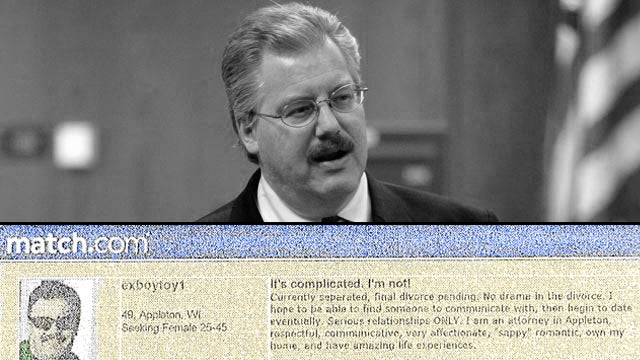
allegations by a variety of women, investigators found Kratz's Match.com
profile and messages. Kratz's username: exboytoy1.
In addition to his repeated and unwanted sexting of Stephanie Van Groll, Kratz was accused
of inviting a woman on a date to an autopsy, and pressuring another
woman to have sex with him so he would support her pardon.
In addition
to these, documents released Friday discuss new allegations. One woman
says Kratz made "sexual advances" her while he was prosecuting her
husband, including asking her to listen while he described "sexual
scenarios" over the phone, offering to "send [her] to Chicago to learn
how to be submissive" and fondling her under her skirt (this was
consensual).
A social worker accuses him of sending inappropriate emails
(more on this below).
A woman whom Kratz had prosecuted said he told
her to perform oral sex on him or he could "get her jammed up" (this
woman was apparently deemed
an unreliable witness because she has mental illness and a criminal
record).
Several women came forward with other complaints — one said
Kratz asked her 17-year-old daughter inappropriate questions after she
was the victim of a sex offender, while another said Kratz once told
her, at work, "I won't cum in your mouth."
Several of the women above saved email correspondences between
themselves and Kratz, and the woman he asked on the autopsy date saved
their Match.com correspondence.
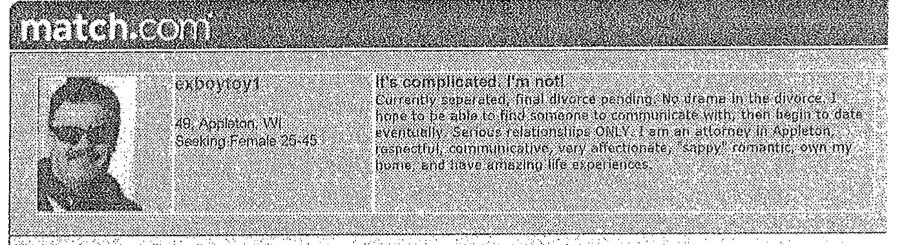
Here's Kratz's profile summary:
If you're having trouble reading the grey-on-grey, the text reads:
It's complicated, I'm not!
Currently separated, final
divorce pending. No drama in the divorce. I hope to be able to find
someone to communicate with, then begin to date eventually. Serious
relationships ONLY. I am an attorney in Appleton, respectful,
communicative, very affectionate, "sappy" romantic, own my home, and
have amazing life experiences.
By January 2010, when
Kratz began messaging the woman in question, these "amazing life
experiences" already included several alleged incidents of harassment,
including the 30 racy text messages
he sent to Stephanie Van Groll in 2009 (he wasn't kidding about being
communicative). It may also be true that his divorce was drama-free, but
he failed to mention that it was his third. Complicated indeed!
Here's the first message the woman provided, sent by Kratz on January 8:
ironic
Its [sic, as is
everything else from here on out] ironic that the woman who probably
struck the sharpets chord with me is the one that I find most
interesting. The fact that you accepted my explaination (despite the
twinge of arrogance left therein) demonstrates the depth of your
personality...any assumption that I made about you skaking through life
on your looks has been dispelled.
Not only would I welcome an opportunity to meet you for some conversation, I'd be honorred.
[Name
redacted], you have left an impression with me that is far removed from
the plastic coated responses I otherwise receive...even the women who
are "thrilled" to talk to me have a veneer of animation to them. There
is nothing fake about you.
Thank you for your response. You are a stunning and impressive woman. I would live to take you to dinner. Write soon. Thank you.
Ken
The fact that the woman in question both struck a chord with Kratz and interested him does not appear to be ironic, but what is
ironic is that Kratz fancied himself something of a writing expert,
mocking a social worker (not his Match.com contact) for using the word
"conflictual" in a report. He said it wasn't a word; it is one. Unlike, say, "skaking." When the social worker set him straight about
"conflictual," he replied "you can either flirt with me or not — you
can't have it both ways." She told him she wasn't interested in
flirting, and the matter dropped, although she says he did comment to
her about a reporter who had "big, beautiful breasts."
But back to the
Match.com story — here's Kratz's next message (sent at 12:45 AM on Jan.
12):
Re: ironic
Wednesday? Let me know if we can do it before you leave—-Im hungry!
By
the way is this a date (where I get to hold out hope of seeing you
eventually) or a lunch with a possible friend thing, where I get to see
how beautiful you are but realize that never in a million years will you
be holdingher???
I have so many questions for you, seems you wont get in any edgewise!!!
If we do go to dinner and its a date, can I pick out the heels you will wear? I find that entertaining!
OK, talk soon, my phone [redacted by DOJ]...text or call anytime!!!
Ken
Kratz
appears to have been quite the fan of heels — he'd subsequently ask her
to wear them to a crime scene, and later to the autopsy (she declined
both). At 7:57 the next morning, he apparently felt he had come on a
little strong:
plans
I re-read my message from last night. Guess I was a little impatient.
OK,
lets try this again... If you have to leave town, just call next week
when we can schedule something! I am truly looking forward to taking you
to a lovely dinner (I'm sure whatever heels you pick will be
beautiful—-LOL).
Regarding whether this is a "date" or not, we are
both single and if there is some spark great, we'll go from there. If
not, you will always have me available as a friend of yours. We don't
have to "call" this anything! Call or text me.
Better?
Ken
And finally:
RE: plans
If I get 1 meal with you, dinner for sure!
Friday or Saturday is best...but I will make myself available when you
are free. What kind of food do you like? Green Bay, Appleton, in
between...everything works.
I am a little "taken" by you. Im sorry I sound like Im in 7th grade. Obvious that doesn't happen to me very often
Let me know, and Im there! Thanks again..
Ken
Ken
and the woman did end up having dinner at the Black and Tan restaurant
in Green Bay, and it was there that he — according to her testimony —
took several phone calls and discussed an ongoing missing-person
investigation with detectives while at the table with her. He also told
her he suspected that the missing woman's boyfriend had murdered her,
and invited her to the crime scene (in heels, natch), all while getting
increasingly drunk. She says "DA Kratz was not worried about drinking
and driving, and she felt he thought he was 'above the law.' DA Kratz
told [her] that he would not have a problem if he was stopped while
driving home because he had friends."
In the days that followed, Kratz
continued to text her with unreleased information about the case,
including the fact that investigators had discovered a body. That's when
he invited her to the autopsy, "as long as she would wear heels and act
as his girlfriend." According to the documents, she "stated that she
thought this was wrong on so many levels." There was apparently no
second date.
The woman's statement and the e-mails sent by Kratz can be found at the following link:
I came across this article that Zellner tweeted a link to recently and
found it Interesting that even Kratz's peers/colleagues think his
behavior was unethical and wrong (although he still defends his actions
- cause he is THE PRIZE!)...
-- "To me, those press conferences would suggest a colorable
violation of the (bar association) trial publicity rule. The risks of
prejudice are magnified in smaller communities because of the pervasive
nature of the publicity and the likelihood that virtually the entire
community will have strong feelings about the case. The Avery case
appeared to have captured the attention of the Fox Valley market ... and
you cannot un-ring that bell."
----Ben Kempinen, University of Wisconsin Law School clinical
professor of law and director of the Prosecution Project.
Prosecutors are not supposed to be making public statements prior to a defendant's trial regarding the following areas:
"The character, credibility, reputation or criminal record of a
party, suspect in a criminal investigation or witness, or the identity
of a witness, or the expected testimony of a party or witness."
"The identity or nature of physical evidence expected to be presented."
"Any opinion as to the guilt or innocence of a defendant or suspect in a
criminal case or proceeding that could result in deprivation of
liberty."
"Information the lawyer knows or reasonably should know is likely to be
inadmissible evidence in a trial and would, if disclosed, create a
substantial risk of prejudicing an impartial trial."
Abbe Smith, director of the criminal defense and prisoner advocacy
clinic at Georgetown University, said Kratz's opening declaration in his
March 2, 2006, press conference exclaiming "we now have determined" and
his continuing comments about Dassey supposedly hearing screams and
running over to his uncle's trailer were highly improper for a press
briefing.
"It's unethical behavior with no legitimate purpose," Smith told USA
TODAY NETWORK-Wisconsin. "Prosecutors should err on the side of not
inflaming the public. To prosecute a case in the media damages the legal
system because you're prejudicing the jury process."
*"There is absolutely no purpose for any of this stuff that Ken Kratz did," *
said Ritnour, who served two terms in two largely rural counties
similar to Manitowoc and Calumet counties, from 2003 through 2010.
"He
likes and wants his name out there. He is definitely trying to get to
the people who will then be in the jury pool. Even if Kratz loses (at
trial), he still kind of wins anyway because he convicted Avery and
Dassey in the court of public opinion."
However, several lawyers and courtroom experts said that
Kratz's behavior was clearly inappropriate for any prosecutor because
his statements were eroding the opportunity for Dassey and Avery to
receive a fair and impartial jury trial.
FORENSIC EXPERT: KRATZ GIVES FALSE STORY.
Brent Turvey, a nationally recognized forensic scientist and criminal
profiler in Alaska, said the crime scene evidence collected from inside
of the Avery residence does not match up with Kratz's salacious and
inflammatory press conference statements around the time of Dassey's
arrest and purported confession to the pair of investigators.
Ken Kratz gives this false story," Turvey said. "It's pure
fantasy. The entire theory comes from the fantasies of these police
investigators (interviewing Dassey). The problem here is that (Kratz)
gave false information, this whole sexual fantasy, talking about Teresa
Halbach talking and begging and yelling when none of this had any
forensic science to back it up.
"Why does this matter? Because you are not allowed to gin up
the public and misrepresent the evidence when talking to the press, and
the only reason you do that is when you and the police don't have a good
case to begin with. Ken Kratz was trying this case in the press to
disparage the defendants. What these judges should have done was put a
gag order in place. There should have been some consequences from the
Wisconsin Bar Association, and the judge who is seeing this nonsense go
on should have put a stop to this. Nobody in this case wanted a fair
trial."
Link to motion that lists ALL of publicity (and actual wording) of media coverage - including Kratz's:
The Wisconsin prosecutor who convicted Steven Avery, the subject of the blockbuster documentary Making a Murderer,
bragged about his role in the controversial case to impress women he
wanted to date and was accused multiple times of abusing his official
position to coerce women into sexual conversations and acts, according
to documents obtained by Newsweek.