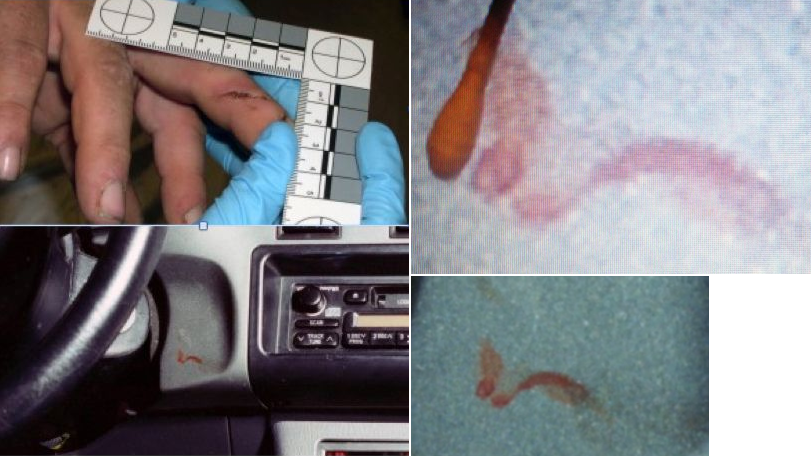
 The blood smear by the ignition switch of Teresa Halbach's RAV4
"Experts experiments confirm SA's trial attorneys correct about blood being planted but incorrect about how it was done. #MakingAMurderer" - Kathleen Zellner, Twitter, December 4, 2016UPDATE JUNE 13, 2017: The following are excerpts from Kathleen Zellner's motion for post-conviction relief filed on June 7, 2017. In the motion she explains that the blood planted in Teresa Halbach's RAV4 came from Steven Avery's bathroom sink on the evening of November 3rd, after he reopend a cut to his right middle finger and dripped blood into the sink, neglecting to clean it up because his brother Chuck was waiting for him, so that they could drive to Menards; and when he came home that night he went straight to bed, not noticing until the next morning that most of the blood in the sink was gone.
Post-Conviction Exhibits #8. Group exhibit of video recordings from news interviews of Steven Avery (11/9 WFRV, 11/18, WBAY), in which he states that he believes law enforcement removed his blood from his trailer, and in one interview states he believes law enforcement removed his blood from his sink.
Mr. James will testify that the blood stains in the RAV-4 were selectively planted and one blood stain was placed by the ignition with an applicator. Mr. James will testify that Mr. Avery's blood did not come from the 1996 blood vial, but was instead blood dripped by Mr. Avery into his bathroom sink in 2005, which was removed and dripped into the RAV-4. Mr. James will testify that the blood stain on the rear cargo door was not the result of Ms. Halbach being thrown into the rear cargo area of the RAV-4 after she had been shot, as the State contended.
Failure of Trial Defense Counsel to Investigate Mr. Avery's Claim that His Blood Was Removed from His Bathroom Sink and Planted in the RAV-4
On the evening of November 3, 2005, Mr. Avery was having dinner at his mother's residence, and when he walked outside her residence, a uniformed officer pulled up in a MCSD squad car and asked if he could speak with him. Later, Mr. Avery learned that this individual's name was Sgt. Colborn. Sgt. Colborn asked Mr. Avery if a female from AutoTrader Magazine had come to the property on Monday to take pictures of a vehicle they were selling. Mr. Avery told Sgt. Colborn that a female from AutoTrader had come to the property at approximately 2:30 p.m. and had photographed a van his sister was selling. Mr. Avery contended that she was on the property for less than five minutes. Mr. Avery told Sgt. Colborn that he noticed her photographing the van and he exited his trailer to pay her. Mr. Avery observed Ms. Halbach leave the property and turn left on Highway 147. Sgt. Colborn misrepresented, in a report written months later, that Mr. Avery said 3:00 p.m., not 2:30 p.m. Mr. Avery's affidavit is consistent with all of his prior statements to police that Ms. Halbach was on the Avery property sometime between 2:00 p.m. and 2:30 p.m. (Affidavit of Steven A. Avery, Sr. "Affidavit of Steven Avery", attached and incorporated herein as P-C Exhibit 4).ORIGINAL POST, PUBLISHED MARCH 14, 2017
Mr. Avery then drove his Pontiac Grand Am from his parents' residence to its usual parking spot in front of his garage. Mr. Avery then walked next door to his sister's trailer, where he attempted to unhitch the trailer. In so doing, Mr. Avery broke open the cut on the middle finger of his right hand. His finger was dripping blood as he walked back to his car to retrieve his cell phone charger. While in his car, Mr. Avery dripped blood from his finger onto the seats and the gear shift. From his car, Mr. Avery walked to his trailer, entering through the door at the south end. Mr. Avery dripped blood on the floor as he entered the bathroom to find a piece of tape to put on the cut. Mr. Avery dripped blood onto the rim and basin of the sink and the bathroom floor. He did not wash away or wipe up the floor or sink because his brother Charles Avery ("Chuck") was waiting for him to go to Menards in Manitowoc with him. He hastily wrapped his finger in masking tape and exited the trailer through the front door. Mr. Avery forgot to lock the south door on the front of the trailer. He did not clean the blood out of his sink prior to leaving the trailer at approximately 7:30 p.m. to go to Menards with his brother Chuck. (Affidavit of Steven Avery, P-C Exhibit 4). Menards in Manitowoc was an approximately 23-minute drive from the Avery property. (Affidavit of Steven Avery, P-C Exhibit 4). Mr. Avery and Chuck checked out at Menards at 8:06 p.m. (Menards Surveillance Video, attached and incorporated herein as P-C Exhibit 5).
Blood stains were noted on the molding (Item AA) and the inside living room door (Item CQ) of Mr. Avery's trailer. (3/31/2006 WSCL DNA Report, attached and herein as P-C Exhibit 6, STATE 5245, 5249). Mr. Avery's Pontiac was unlocked and visible blood was on the gear shift. Anyone who examined the interior of his trailer or vehicle would have recognized that the locations of the various blood stains indicated Mr. Avery had a cut on his hand. (Affidavit of Steven Avery, P-C Exhibit 4).
Mr. Johnson, a family friend of the Avery's and owner of Mr. Avery's trailer, remembers observing the cut on Mr. Avery's finger at least one week prior to October 31, 2005. (Affidavit of Roland A. Johnson, "Affidavit of Rollie Johnson," attached and incorporated herein as P-C Exhibit 7).
At approximately 7:30 p.m., Mr. Avery was exiting the Avery property onto Highway 147 when he observed taillights of a vehicle close to the front of his trailer. (Affidavit of Steven Avery, P-C Exhibit 4; Menards Surveillance Video, P-C Exhibit 5). Mr. Avery contends that the only way the vehicle could enter his property from the direction it was pointed was if it was driven by way of Kuss Road and then across the field to the front of his trailer. Mr. Avery believes the vehicle's taillights were similar to those of the RAV-4 and not a squad car. Mr. Avery instructed his brother Chuck to turn around and drive back to the trailer, but by the time they drove back to Mr. Avery's trailer, the vehicle had departed into the darkness. (Affidavit of Steven Avery, P-C Exhibit 4). Mr. Avery and Chuck went to Menards and the county jail to drop off money for Mr. Avery's girlfriend. (Affidavit of Steven Avery, P-C Exhibit 4). Mr. Avery arrived home at approximately 10:00-10:30 p.m. Mr. Avery did not enter the bathroom and went straight to bed. (Affidavit of Steven Avery, P-C Exhibit 4).
On November 4, 2005, Mr. Avery awoke at his normal time of 6:00 a.m. When he entered the bathroom of his trailer to take a shower, he observed that most of the blood in and around his sink had been removed. (Affidavit of Steven Avery, P-C Exhibit 4).
Mr. Avery consistently expressed his belief to his attorneys and the media that the blood of his found in Ms. Halbach's vehicle was planted and that it came from his trailer. In one interview, he said he dripped blood from his finger into his bathroom sink. (Video Clips from 11/9/05 NBC-26 WFRV interview and 11/18/05 WBAY interview, attached and incorporated herein as P-C Group Exhibit 8).
At 10:30 a.m. on November 4, 2005, Lt. Lenk and Det. Remiker arrived at the Avery property to interview Mr. Avery. (Pages from MTSO Summary Report, P-C Group Exhibit 11, STATE 80). In the early evening, Mr. Avery smelled cigarette smoke when he entered his bedroom to retrieve a cable for his mother's television. Neither Mr. Avery nor his girlfriend smoked. Mr. Avery believes his trailer was entered unlawfully a second time. (Affidavit of Steven Avery, P-C Exhibit 4; 11/9/05 Interview of Steven Avery and Execution of Search Warrant, "11/9/05 Execution of Search Warrant," attached and incorporated herein as P-C Exhibit 9, STATE 553-54).
On November 5, 2005, when Mr. Avery was preparing to leave for a trip to the family properly in Crivitz, he noticed the south front door of his trailer had been pried open. Specifically, Mr. Avery observed pry marks on the south door of his trailer. (Affidavit of Steven Avery, P-C Exhibit 4; Affidavit of Rollie Johnson, P-C Exhibit 7). He remembered locking this door after Lt. Lenk and Det. Remiker left on the morning of November 4, 2005. (Affidavit of Steven Avery, P-C Exhibit 4).
As Mr. Avery's brother Chuck left for Crivitz, he observed headlights in the area where Ms. Halbach's vehicle was discovered by the pond. Chuck called Mr. Avery at 7:20 pm. to check on the headlights, but by the time Mr. Avery arrived by Chuck's trailer, the lights were gone. (Affidavit of Steven Avery P-C Exhibit 4) (Page from Steven Avery's Phone Records, attached and incorporated herein as P-C Exhibit 10) (Pages from MCSD Summary Report verifying Chuck's phone number, attached and incorporated herein as P- C Exhibit 11, STATE 93).
The blood vial was stored in Avery's 1985 case file (a cardboard box) because it was collected in 1996 as part of his 1995 motion for DNA testing to exclude both himself and Penny Beernsten.
EDTA is a blood preservative that would be present in a sample of Avery's blood stored by law enforcement. The FBI said EDTA was not present in the blood found in Teresa Halbach's RAV4.

1. At Avery's trial for the 1985 rape, Penny Beernsten identified Avery as her attacker. A state forensic examiner testified that a hair recovered from a shirt of Avery’s was consistent with Beernsten’s hair. Avery presented 16 alibi witnesses, including the clerk of a store in Green Bay, Wisconsin, who recalled Avery, accompanied by his wife and five children, buying paint from the store. A checkout tape put the purchase at 5:13 p.m. Beernsten put the attack at 3:50 p.m. and estimated it lasted 15 minutes, which meant that Avery would have to leave the scene of the attack, walk a mile to the nearest parking area, drive home, load his family into the car, and drive 45 miles in just over an hour.
2. After losing several appeals, on June 13, 1995, Avery’s new attorney filed a motion with the trial court seeking the release of certain evidence for DNA testing, stating that “DNA testing would exclude both the victim and Mr. Avery. They collected a vial of blood from him in 1996 for the appeal.
3. A petition for DNA testing was granted in 1995 and showed that scrapings taken of Beernsten’s fingernails contained the DNA of an unknown person. The court ruled that the tests were unable to eliminate Avery, and a motion for a new trial was denied. There were two separate DNA samples that could have led to Avery's release. The first one proved inconclusive. As the Innocence Project, which took on Avery's case, reported, a fingernail scraping sample showed that there was unknown DNA underneath Beerntsen's nails. But as the Netflix series explained, DNA in that situation can only be broken down into groups called "alleles." And though there were alleles that matched Avery, there were also alleles that could not have belonged to him. However, because he was a match for some of the DNA, the Wisconsin Court of Appeals found that "the DNA evidence does not make it any more or less probable that Avery assaulted P.B."
4. On April 23, 1996, Avery filed a motion for postconviction relief, requesting “an order vacating the conviction and sentence in this matter and granting him a new trial on the grounds that evidence demonstrates a reasonable probability of a different result on retrial.” Avery’s motion, based on the DNA testing results, stated that the “DNA analysis of fingernail scrapings from the victim constitute newly-discovered evidence and reveal the presence of DNA which could not have come from either the victim or Mr. Avery” and that “such DNA most likely came from the perpetrator of this offense.”
5. On July 29, 1996, Avery filed a supplemental motion for postconviction relief requesting “an order vacating the conviction and sentence in this matter and granting him a new trial on the grounds that the state withheld material, exculpatory evidence at the time of trial.” Avery’s motion was based on his recent discovery that, prior to trial, the sheriff’s department had failed to provide either Avery or Avery’s trial counsel with information regarding an “alternative suspect living in Sheboygan County who matched the description of the perpetrator.” The trial court conducted a hearing on Avery’s motion for a new trial on the basis of newly-discovered evidence. According to the expert who conducted the forensic DNA testing: there was DNA present in the scrapings taken from P.B.’s fingernails that did not match DNA samples from either Avery or P.B; thus, “there was at least one additional individual present.” Therefore, the trial court denied the motion for a new trial, even though P.B. said there was only one assailant and even though she never mentioned another individual present.
6. The 1996 vial of Avery's blood, collected for the appeal filed in 1995, was stored in a cardboard box (exhibit 468) at the office of the Clerk of the Court for Manitowoc County, along with other evidence from his 1985 case.
7. In April of 2002, attorneys for the Wisconsin Innocence Project obtained a court order for DNA testing of 13 hairs recovered from P.B. at the time of the crime. The state crime laboratory reported that, using the FBI DNA database, it had linked a hair to Gregory Allen, a convicted felon who bore a resemblance to Avery. Allen was then serving a 60-year prison term for a sexual assault in Green Bay that occurred after the attack on P.B.
8. In September 2002, a Circuit Court judge signed an order for two items of evidence from the Avery's 1985 court file (hair and fingernail cuttings) be transferred to the State Crime Lab in Madison for further DNA testing. This court file also would have contained Avery's 1996 blood vial. Lenk, who was the "designated evidence custodian" for the entire Manitowoc County Sheriff's department at the time, claimed during Avery's 2007 trial that he did not access the evidence box and that he sent a deputy named Mike Shallue with a presigned form to retrieve hair and fingernail cuttings as ordered by the court. When Shallue retrieved the items of evidence, Lenk said he didn't check to see which items Shallue actually retrieved from the box at the Clerk of the Court's Office because he "trusted him and the court" with the task.
9. The buccal swabs that had been collected from Avery in 1985 were in Sherry Culhane’s possession in 2002-2003 to test Avery’s DNA for the court order obtained by the Wisconsin Innocence Project. This testing eventually led to his exoneration and release from prison for his wrongful conviction in the sexual assault against Penny Beersten.

10. On September 11, 2003, a request brought by the Manitowoc District Attorney’s Office and the Wisconsin Innocence Project to dismiss the charges was granted and Avery was released after serving 18 years for the sexual assault of Penny Beersten, a crime he didn't commit. Gregory Allen, a felon and "notorious sexual predator" who resembled Avery, actually better fit Beersten's description of her attacker. And DNA in a pubic hair found on Beersten after her attack was found to have, in fact, belonged to Allen, not Avery. And that single bit of evidence freed Avery after he spent nearly two decades in prison.
11. In 2003, Culhane returned Avery's 1985 buccal swabs to Manitowoc County. They were received by Dave Remiker on October 13, 2003. Therefore, since October 2003, MTSO has had Avery’s buccal swabs from his 1985 conviction, which could have been used to plant DNA or to mix with someone else's blood to fabricate blood DNA.


There may have been opportunity for blood other than the 1996 vial:
1. Apparently, in 1985, which was pre-DNA testing, they didn't collect blood from Avery. Or did they collect blood from him in 1985, and the 1985 vial is missing from his case file because it was used to plant Avery's blood in 2005?
2. There may also be a 2001-2003 vial of Avery's blood missing from the Fox Lake prison hospital (search the comments to this blog post for "Raduenz").
There are a couple of possibilities as far as the source of blood other than a blood vial:
1. Blood in Avery's trailer from cutting his finger. Regarding the CD box found in Teresa's RAV4, Nick Stahlke described the blood as "basically covering 50 percent of the surface of this CD box," (day 11 page 209). Maybe Avery's blood that dripped from his cut finger was collected from his home, reconstituted with water or saline, and the CD box was used as a "palette" when planting the blood in the RAV4.
2. Blood from the Grand Am that Avery drove to Crivitz the morning of November 5th, or a bloody rag found inside the vehicle when it was seized on November 6th (it would make sense that Avery used a rag of some sort to wrap his cut finger, and that rag could have been inside the Grand Am when it was seized on November 6th).
Note: A bloody rag was not collected by Wendy Baldwin from Avery's Grand Am on November 5th. Wendy Baldwin collected a bloody rag from a silver station wagon near the pond in the salvage yard at 9:03 a.m. on November 6th, when the Grand Am was in Marinette County (CASO page 109).Below is a screen shot from NBC26's November 8th interview with Steven Avery. The cut to his finger is no longer bandaged or bleeding and is in the process of healing. Avery told Milwaukee Magazine ("Blood Simple") that he cut his finger loading tin roofing onto a flatbed, and every time the cut was reopened he "bled like a stuffed pig." He said he reopened the cut on November 5th when helping install a tin roof in Crivitz. Nobody, including law enforcement, asked Steven Avery when he orignally cut his finger. In fact, in Avery's November 5th and 6th interviews in Crivitz, neither DCI Agent Skorlinksi nor Marinette County deputy O'Neill noted the cut to Steven's finger. A women is missing and your main suspect has a fresh cut to his finger, but you don't ask him about when and how he cut it?

Detectives said Roland Johnson told them on February 6, 2006 that he saw Steven Avery "just prior" to Halloween 2005 (day 19 page 148). He said it wasn't unusual for Allan Avery and his sons to have cuts since they worked in a junkyard, but he noticed this particular cut to Steven's hand or finger because it was a "pretty nasty gash" that he thought needed stitches. Because Roland wasn't interviewed until three months after Teresa went missing, his recollection was vague. Roland testified he saw Avery with a cut that looked similar to Exhibit 19. He also testified he saw Avery within a month of Halloween and that it could have been a week before Halloween but he couldn't remember.
Chuck Avery told Marinette County deputy Sievert on November 7th that he and Steven left for Menard's in the flatbed at 6:30 p.m. on Thursday and "picked up trusses and insulation and a few odds and ends." Blaine Dassey told DCI agents on November 11th that Chuck and Steven asked him if he wanted to go to Menard's with them to get the "trusses for a shed they were going to build up north." Steven told Skorlinski on November 6th that he and Chuck loaded a TV onto the flatbed around 5 p.m. on Friday. He said: "The insulation was all there and everything else. So it was all loaded. All we had to do was the TV and tie it down."
Nobody mentioned loading tin roofing during the week of October 31st; however, we know that tin was in Crivitz the weekend of November 5th because Steven reopened the cut installing the roofing on that day. The tin roofing must have been loaded onto the flatbed on Thursday, November 3rd and then driven by Chuck to Crivitz on Friday, November 4th, or it was loaded the week before Halloween and driven to the cabin in Crivitz on Friday or Saturday, October 28 or 29th. This means Lenk and Remiker would have seen that Steven had a cut to his finger when he allowed them to search his trailer without a warrant on the morning of November 4th (they insisted Steven be present during the search).


![[IMG]](https://blogger.googleusercontent.com/img/proxy/AVvXsEjGeYMREKJfQztEaz0u8CsvWoCy1X0sLrFtcLKxSqm5YdT4nFE8FMdarH6IbUFOxiSeYse9nWzaxBTG-Y9NAhGnHTaCm2hV9cRdKuc7MnR9CsSgUn3vo642kza4n-le=s0-d)

![[IMG]](https://blogger.googleusercontent.com/img/proxy/AVvXsEjlEaAsEOO0I6aET0ccKKFDFmApR2oldVpuSEi-JwBf9oTT7N-8gsAQ4M-9YuTJ3Qa2fR0gc3dySzi94FRmfY5eMk7d3hqTCEVMqePU1j_YaslrolL1ewFqVXBNwD7l=s0-d)


