Showing posts with label Avery's Blood. Show all posts

Tuesday, March 14, 2017

There Was Opportunity for Blood Beyond the 1996 Vial [Updated 06-13-2017]

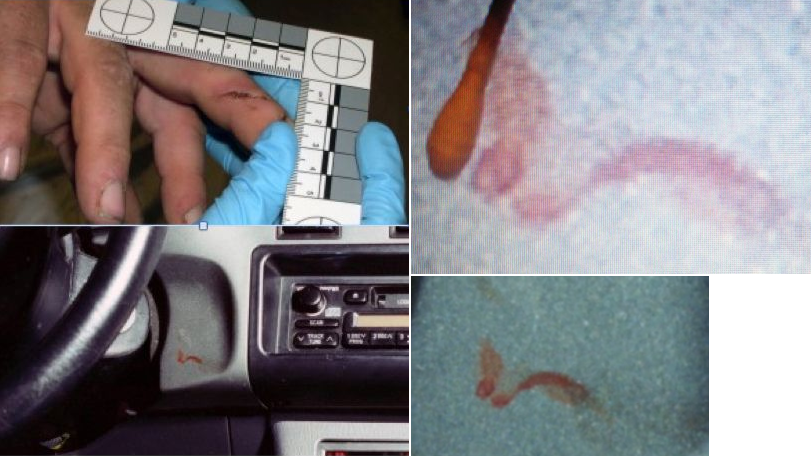
georgezipperer.blogspot.com The blood smear by the ignition switch of Teresa Halbach's RAV4
"Experts experiments confirm SA's trial attorneys correct about blood being planted but incorrect about how it was done. #MakingAMurderer" - Kathleen Zellner, Twitter, December 4, 2016
UPDATE JUNE 13, 2017: The following are excerpts from Kathleen Zellner's motion for post-conviction relief filed on June 7, 2017. In the motion she explains that the blood planted in Teresa Halbach's RAV4 came from Steven Avery's bathroom sink on the evening of November 3rd, after he reopend a cut to his right middle finger and dripped blood into the sink, neglecting to clean it up because his brother Chuck was waiting for him, so that they could drive to Menards; and when he came home that night he went straight to bed, not noticing until the next morning that most of the blood in the sink was gone. 
Post-Conviction Exhibits #8. Group exhibit of video recordings from news interviews of Steven Avery (11/9 WFRV, 11/18, WBAY), in which he states that he believes law enforcement removed his blood from his trailer, and in one interview states he believes law enforcement removed his blood from his sink.

Mr. James will testify that the blood stains in the RAV-4 were selectively planted and one blood stain was placed by the ignition with an applicator. Mr. James will testify that Mr. Avery's blood did not come from the 1996 blood vial, but was instead blood dripped by Mr. Avery into his bathroom sink in 2005, which was removed and dripped into the RAV-4. Mr. James will testify that the blood stain on the rear cargo door was not the result of Ms. Halbach being thrown into the rear cargo area of the RAV-4 after she had been shot, as the State contended. 

Failure of Trial Defense Counsel to Investigate Mr. Avery's Claim that His Blood Was Removed from His Bathroom Sink and Planted in the RAV-4
On the evening of November 3, 2005, Mr. Avery was having dinner at his mother's residence, and when he walked outside her residence, a uniformed officer pulled up in a MCSD squad car and asked if he could speak with him. Later, Mr. Avery learned that this individual's name was Sgt. Colborn. Sgt. Colborn asked Mr. Avery if a female from AutoTrader Magazine had come to the property on Monday to take pictures of a vehicle they were selling. Mr. Avery told Sgt. Colborn that a female from AutoTrader had come to the property at approximately 2:30 p.m. and had photographed a van his sister was selling. Mr. Avery contended that she was on the property for less than five minutes. Mr. Avery told Sgt. Colborn that he noticed her photographing the van and he exited his trailer to pay her. Mr. Avery observed Ms. Halbach leave the property and turn left on Highway 147. Sgt. Colborn misrepresented, in a report written months later, that Mr. Avery said 3:00 p.m., not 2:30 p.m. Mr. Avery's affidavit is consistent with all of his prior statements to police that Ms. Halbach was on the Avery property sometime between 2:00 p.m. and 2:30 p.m. (Affidavit of Steven A. Avery, Sr. "Affidavit of Steven Avery", attached and incorporated herein as P-C Exhibit 4).

Mr. Avery then drove his Pontiac Grand Am from his parents' residence to its usual parking spot in front of his garage. Mr. Avery then walked next door to his sister's trailer, where he attempted to unhitch the trailer. In so doing, Mr. Avery broke open the cut on the middle finger of his right hand. His finger was dripping blood as he walked back to his car to retrieve his cell phone charger. While in his car, Mr. Avery dripped blood from his finger onto the seats and the gear shift. From his car, Mr. Avery walked to his trailer, entering through the door at the south end. Mr. Avery dripped blood on the floor as he entered the bathroom to find a piece of tape to put on the cut. Mr. Avery dripped blood onto the rim and basin of the sink and the bathroom floor. He did not wash away or wipe up the floor or sink because his brother Charles Avery ("Chuck") was waiting for him to go to Menards in Manitowoc with him. He hastily wrapped his finger in masking tape and exited the trailer through the front door. Mr. Avery forgot to lock the south door on the front of the trailer. He did not clean the blood out of his sink prior to leaving the trailer at approximately 7:30 p.m. to go to Menards with his brother Chuck. (Affidavit of Steven Avery, P-C Exhibit 4). Menards in Manitowoc was an approximately 23-minute drive from the Avery property. (Affidavit of Steven Avery, P-C Exhibit 4). Mr. Avery and Chuck checked out at Menards at 8:06 p.m. (Menards Surveillance Video, attached and incorporated herein as P-C Exhibit 5).

Blood stains were noted on the molding (Item AA) and the inside living room door (Item CQ) of Mr. Avery's trailer. (3/31/2006 WSCL DNA Report, attached and herein as P-C Exhibit 6, STATE 5245, 5249). Mr. Avery's Pontiac was unlocked and visible blood was on the gear shift. Anyone who examined the interior of his trailer or vehicle would have recognized that the locations of the various blood stains indicated Mr. Avery had a cut on his hand. (Affidavit of Steven Avery, P-C Exhibit 4).

Mr. Johnson, a family friend of the Avery's and owner of Mr. Avery's trailer, remembers observing the cut on Mr. Avery's finger at least one week prior to October 31, 2005. (Affidavit of Roland A. Johnson, "Affidavit of Rollie Johnson," attached and incorporated herein as P-C Exhibit 7).

At approximately 7:30 p.m., Mr. Avery was exiting the Avery property onto Highway 147 when he observed taillights of a vehicle close to the front of his trailer. (Affidavit of Steven Avery, P-C Exhibit 4; Menards Surveillance Video, P-C Exhibit 5). Mr. Avery contends that the only way the vehicle could enter his property from the direction it was pointed was if it was driven by way of Kuss Road and then across the field to the front of his trailer. Mr. Avery believes the vehicle's taillights were similar to those of the RAV-4 and not a squad car. Mr. Avery instructed his brother Chuck to turn around and drive back to the trailer, but by the time they drove back to Mr. Avery's trailer, the vehicle had departed into the darkness. (Affidavit of Steven Avery, P-C Exhibit 4). Mr. Avery and Chuck went to Menards and the county jail to drop off money for Mr. Avery's girlfriend. (Affidavit of Steven Avery, P-C Exhibit 4). Mr. Avery arrived home at approximately 10:00-10:30 p.m.  Mr. Avery did not enter the bathroom and went straight to bed. (Affidavit of Steven Avery, P-C Exhibit 4).

On November 4, 2005, Mr. Avery awoke at his normal time of 6:00 a.m. When he entered the bathroom of his trailer to take a shower, he observed that most of the blood in and around his sink had been removed. (Affidavit of Steven Avery, P-C Exhibit 4).

Mr. Avery consistently expressed his belief to his attorneys and the media that the blood of his found in Ms. Halbach's vehicle was planted and that it came from his trailer. In one interview, he said he dripped blood from his finger into his bathroom sink. (Video Clips from 11/9/05 NBC-26 WFRV interview and 11/18/05 WBAY interview, attached and incorporated herein as P-C Group Exhibit 8).

At 10:30 a.m. on November 4, 2005, Lt. Lenk and Det. Remiker arrived at the Avery property to interview Mr. Avery. (Pages from MTSO Summary Report, P-C Group Exhibit 11, STATE 80). In the early evening, Mr. Avery smelled cigarette smoke when he entered his bedroom to retrieve a cable for his mother's television. Neither Mr. Avery nor his girlfriend smoked. Mr. Avery believes his trailer was entered unlawfully a second time. (Affidavit of Steven Avery, P-C Exhibit 4; 11/9/05 Interview of Steven Avery and Execution of Search Warrant, "11/9/05 Execution of Search Warrant," attached and incorporated herein as P-C Exhibit 9, STATE 553-54).

On November 5, 2005, when Mr. Avery was preparing to leave for a trip to the family properly in Crivitz, he noticed the south front door of his trailer had been pried open. Specifically, Mr. Avery observed pry marks on the south door of his trailer. (Affidavit of Steven Avery, P-C Exhibit 4; Affidavit of Rollie Johnson, P-C Exhibit 7). He remembered locking this door after Lt. Lenk and Det. Remiker left on the morning of November 4, 2005. (Affidavit of Steven Avery, P-C Exhibit 4).

As Mr. Avery's brother Chuck left for Crivitz, he observed headlights in the area where Ms. Halbach's vehicle was discovered by the pond. Chuck called Mr. Avery at 7:20 pm. to check on the headlights, but by the time Mr. Avery arrived by Chuck's trailer, the lights were gone. (Affidavit of Steven Avery P-C Exhibit 4) (Page from Steven Avery's Phone Records, attached and incorporated herein as P-C Exhibit 10) (Pages from MCSD Summary Report verifying Chuck's phone number, attached and incorporated herein as P- C Exhibit 11, STATE 93).
ORIGINAL POST, PUBLISHED MARCH 14, 2017

The blood vial was stored in Avery's 1985 case file (a cardboard box) because it was collected in 1996 as part of his 1995 motion for DNA testing to exclude both himself and Penny Beernsten.

EDTA is a blood preservative that would be present in a sample of Avery's blood stored by law enforcement. The FBI said EDTA was not present in the blood found in Teresa Halbach's RAV4.

Related image

1. At Avery's trial for the 1985 rape, Penny Beernsten identified Avery as her attacker. A state forensic examiner testified that a hair recovered from a shirt of Avery’s was consistent with Beernsten’s hair. Avery presented 16 alibi witnesses, including the clerk of a store in Green Bay, Wisconsin, who recalled Avery, accompanied by his wife and five children, buying paint from the store. A checkout tape put the purchase at 5:13 p.m. Beernsten put the attack at 3:50 p.m. and estimated it lasted 15 minutes, which meant that Avery would have to leave the scene of the attack, walk a mile to the nearest parking area, drive home, load his family into the car, and drive 45 miles in just over an hour.

2. After losing several appeals, on June 13, 1995, Avery’s new attorney filed a motion with the trial court seeking the release of certain evidence for DNA testing, stating that “DNA testing would exclude both the victim and Mr. Avery. They collected a vial of blood from him in 1996 for the appeal.

3. A petition for DNA testing was granted in 1995 and showed that scrapings taken of Beernsten’s fingernails contained the DNA of an unknown person. The court ruled that the tests were unable to eliminate Avery, and a motion for a new trial was denied. There were two separate DNA samples that could have led to Avery's release. The first one proved inconclusive. As the Innocence Project, which took on Avery's case, reported, a fingernail scraping sample showed that there was unknown DNA underneath Beerntsen's nails. But as the Netflix series explained, DNA in that situation can only be broken down into groups called "alleles." And though there were alleles that matched Avery, there were also alleles that could not have belonged to him. However, because he was a match for some of the DNA, the Wisconsin Court of Appeals found that "the DNA evidence does not make it any more or less probable that Avery assaulted P.B."

4. On April 23, 1996, Avery filed a motion for postconviction relief, requesting “an order vacating the conviction and sentence in this matter and granting him a new trial on the grounds that evidence demonstrates a reasonable probability of a different result on retrial.” Avery’s motion, based on the DNA testing results, stated that the “DNA analysis of fingernail scrapings from the victim constitute newly-discovered evidence and reveal the presence of DNA which could not have come from either the victim or Mr. Avery” and that “such DNA most likely came from the perpetrator of this offense.” 

5. On July 29, 1996, Avery filed a supplemental motion for postconviction relief requesting “an order vacating the conviction and sentence in this matter and granting him a new trial on the grounds that the state withheld material, exculpatory evidence at the time of trial.” Avery’s motion was based on his recent discovery that, prior to trial, the sheriff’s department had failed to provide either Avery or Avery’s trial counsel with information regarding an “alternative suspect living in Sheboygan County who matched the description of the perpetrator.” The trial court conducted a hearing on Avery’s motion for a new trial on the basis of newly-discovered evidence. According to the expert who conducted the forensic DNA testing: there was DNA present in the scrapings taken from P.B.’s fingernails that did not match DNA samples from either Avery or P.B; thus, “there was at least one additional individual present.” Therefore, the trial court denied the motion for a new trial, even though P.B. said there was only one assailant and even though she never mentioned another individual present.

6. The 1996 vial of Avery's blood, collected for the appeal filed in 1995, was stored in a cardboard box (exhibit 468) at the office of the Clerk of the Court for Manitowoc County, along with other evidence from his 1985 case. 

7. In April of 2002, attorneys for the Wisconsin Innocence Project obtained a court order for DNA testing of 13 hairs recovered from P.B. at the time of the crime. The state crime laboratory reported that, using the FBI DNA database, it had linked a hair to Gregory Allen, a convicted felon who bore a resemblance to Avery. Allen was then serving a 60-year prison term for a sexual assault in Green Bay that occurred after the attack on P.B.

8. In September 2002, a Circuit Court judge signed an order for two items of evidence from the Avery's 1985 court file (hair and fingernail cuttings) be transferred to the State Crime Lab in Madison for further DNA testing. This court file also would have contained Avery's 1996 blood vial. Lenk, who was the "designated evidence custodian" for the entire Manitowoc County Sheriff's department at the time, claimed during Avery's 2007 trial that he did not access the evidence box and that he sent a deputy named Mike Shallue with a presigned form to retrieve hair and fingernail cuttings as ordered by the court. When Shallue retrieved the items of evidence, Lenk said he didn't check to see which items Shallue actually retrieved from the box at the Clerk of the Court's Office because he "trusted him and the court" with the task.

9. The buccal swabs that had been collected from Avery in 1985 were in Sherry Culhane’s possession in 2002-2003 to test Avery’s DNA for the court order obtained by the Wisconsin Innocence Project. This testing eventually led to his exoneration and release from prison for his wrongful conviction in the sexual assault against Penny Beersten.

Image result for steven avery blood vial

10. On September 11, 2003, a request brought by the Manitowoc District Attorney’s Office and the Wisconsin Innocence Project to dismiss the charges was granted and Avery was released after serving 18 years for the sexual assault of Penny Beersten, a crime he didn't commit. Gregory Allen, a felon and "notorious sexual predator" who resembled Avery, actually better fit Beersten's description of her attacker. And DNA in a pubic hair found on Beersten after her attack was found to have, in fact, belonged to Allen, not Avery. And that single bit of evidence freed Avery after he spent nearly two decades in prison.

11. In 2003, Culhane returned Avery's 1985 buccal swabs to Manitowoc County. They were received by Dave Remiker on October 13, 2003. Therefore, since October 2003, MTSO has had Avery’s buccal swabs from his 1985 conviction, which could have been used to plant DNA or to mix with someone else's blood to fabricate blood DNA.


There may have been opportunity for blood other than the 1996 vial:

1. Apparently, in 1985, which was pre-DNA testing, they didn't collect blood from Avery. Or did they collect blood from him in 1985, and the 1985 vial is missing from his case file because it was used to plant Avery's blood in 2005?

2. There may also be a 2001-2003 vial of Avery's blood missing from the Fox Lake prison hospital (search the comments to this blog post for "Raduenz").

There are a couple of possibilities as far as the source of blood other than a blood vial:

1. Blood in Avery's trailer from cutting his finger. Regarding the CD box found in Teresa's RAV4, Nick Stahlke described the blood as "basically covering 50 percent of the surface of this CD box," (day 11 page 209). Maybe Avery's blood that dripped from his cut finger was collected from his home, reconstituted with water or saline, and the CD box was used as a "palette" when planting the blood in the RAV4.

2. Blood from the Grand Am that Avery drove to Crivitz the morning of November 5th, or a bloody rag found inside the vehicle when it was seized on November 6th (it would make sense that Avery used a rag of some sort to wrap his cut finger, and that rag could have been inside the Grand Am when it was seized on November 6th).
Note: A bloody rag was not collected by Wendy Baldwin from Avery's Grand Am on November 5th. Wendy Baldwin collected a bloody rag from a silver station wagon near the pond in the salvage yard at 9:03 a.m. on November 6th, when the Grand Am was in Marinette County (CASO page 109).
Below is a screen shot from NBC26's November 8th interview with Steven Avery. The cut to his finger is no longer bandaged or bleeding and is in the process of healing. Avery told Milwaukee Magazine ("Blood Simple") that he cut his finger loading tin roofing onto a flatbed, and every time the cut was reopened he "bled like a stuffed pig." He said he reopened the cut on November 5th when helping install a tin roof in Crivitz. Nobody, including law enforcement, asked Steven Avery when he orignally cut his finger. In fact, in Avery's November 5th and 6th interviews in Crivitz, neither DCI Agent Skorlinksi nor Marinette County deputy O'Neill noted the cut to Steven's finger. A women is missing and your main suspect has a fresh cut to his finger, but you don't ask him about when and how he cut it?


Detectives said Roland Johnson told them on February 6, 2006 that he saw Steven Avery "just prior" to Halloween 2005 (day 19 page 148). He said it wasn't unusual for Allan Avery and his sons to have cuts since they worked in a junkyard, but he noticed this particular cut to Steven's hand or finger because it was a "pretty nasty gash" that he thought needed stitches. Because Roland wasn't interviewed until three months after Teresa went missing, his recollection was vague. Roland testified he saw Avery with a cut that looked similar to Exhibit 19. He also testified he saw Avery within a month of Halloween and that it could have been a week before Halloween but he couldn't remember.

Chuck Avery told Marinette County deputy Sievert on November 7th that he and Steven left for Menard's in the flatbed at 6:30 p.m. on Thursday and "picked up trusses and insulation and a few odds and ends." Blaine Dassey told DCI agents on November 11th that Chuck and Steven asked him if he wanted to go to Menard's with them to get the "trusses for a shed they were going to build up north." Steven told Skorlinski on November 6th that he and Chuck loaded a TV onto the flatbed around 5 p.m. on Friday. He said: "The insulation was all there and everything else. So it was all loaded. All we had to do was the TV and tie it down."

Nobody mentioned loading tin roofing during the week of October 31st; however, we know that tin was in Crivitz the weekend of November 5th because Steven reopened the cut installing the roofing on that day. The tin roofing must have been loaded onto the flatbed on Thursday, November 3rd and then driven by Chuck to Crivitz on Friday, November 4th, or it was loaded the week before Halloween and driven to the cabin in Crivitz on Friday or Saturday, October 28 or 29th. This means Lenk and Remiker would have seen that Steven had a cut to his finger when he allowed them to search his trailer without a warrant on the morning of November 4th (they insisted Steven be present during the search).

Wednesday, November 23, 2016

Judge Orders Scientific Testing to Proceed in Steven Avery Case

Kathleen Zellner's Press Conference on 8/26/16 [Full Transcript]

Zellner's Motion for Post-Conviction Scientific Testing, Filed on 8/26/16
Zellner's Motion to Hold Appeal in Abeyance and Suspend the Briefing Schedule, Filed on 8/26/16

Introduction to Parabon Snapshot DNA Phenotyping Service


Law enforcement now has a new DNA tool that helps nab suspects and close cases (video above). The service, developed by Parabon NanoLabs of Reston, Virginia, is called the Parabon® Snapshot™ DNA Phenotyping Service (Snapshot). It predicts the physical appearance of individuals from the smallest of DNA evidence samples, creating a composite image or “snapshot” of any DNA source.
These critical items of evidence will undergo testing as part of the court order:
Blood flakes recovered from the floor near the center console of Halbach’s RAV4.

Bloodstain cutting from the driver’s seat.

Bloodstain cutting from passenger’s seat.

Swab of the RAV4 ignition area where blood was found.

Swab of bloodstain taken from the rear passenger’s door.

Swab of bloodstain taken from a CD case found in vehicle.
Additionally, three other items of evidence used to secure Avery’s arrest and eventual conviction are subject to the new testing order. Those items are:
A vial of blood said to be a sample of Avery’s blood from 1996. This was the vial of blood that Avery’s murder trial defense lawyers Dean Strang and Jerry Buting came across during their pretrial case research inside the clerk’s office at the Manitowoc County Courthouse.

A spare key for Halbach’s vehicle found in Avery’s bedroom by Manitowoc County Sheriff’s deputies James Lenk and Andrew Colborn.

The swab from the hood latch of Halbach’s RAV4 that later generated a DNA profile for Avery. Forensic testing on the hood latch was not performed by the Wisconsin State Crime Lab in Madison, even though the lab initially impounded the vehicle and conducted a battery of standard forensic tests. Rather, the swab of the hood latch that yielded the DNA profile of the murder defendant did not occur until six months later. In April 2006, Calumet County sheriff’s officials decided to carry out their own forensic testing of the hood area. They did not swab the interior hood release.
Zellner has said she wants to determine if the hood latch DNA swab was fabricated from other known DNA samples that were in the possession of Calumet and Manitowoc County law enforcement.
"Testing we've already done will establish that Steven Avery is innocent... The confession [Brendan Dassey's] has been invalidated so were down to the evidence at the crime scene: the key, hood latch, blood in RAV, and bullet... We are going to get to the bottom of who killed Teresa Halbach. And we currently believe that we will establish it was not Steven Avery." - Kathleen Zellner, Press Conference, August 26, 2016
There is a blood stain found at an important position on the RAV4. The blood stain in question, A23, was found on the rear cargo door handle. Below are the results for that stain. Circled in red are mentions of A23 and the relevant results for this stain. The key part is in blue, the claim of insufficient for interpretation (the "insufficient for interpretation" is the opportunity for bias and is, in essence, subjective):


From the official reports we know that Sherry Culhane developed a partial profile from blood stain A23, deemed it insufficient for interpretation, and did not conduct any further testing.

It is possible Kathleen Zellner retested items that were originally tested in the RAV4:
1) In 2007, Judge Willis ordered that Avery or his attorney could retest the blood evidence from the RAV4 at any time.

2) Willis' order did not include new testing (though Zellner cited Wisconsin law and then presented how she has met the criteria for new testing) and didn't include the retesting of ALL the other evidence. So, in Zellner's motion for post-conviction scientific testing, she is requesting new testing and to retest other evidence from the original trial.
There could be someone else's blood or DNA mixed with the blood found in the RAV4's cargo area. Zellner specifically pointed out in her motion:
"One of the most compelling scientific facts pointing to planted blood evidence is that there was no mixture of Ms. Halbach's and Mr. Avery's blood despite the State's claim that the bleeding Mr. Avery threw Ms. Halbach in the rear cargo area of her vehicle."
Zellner told reporters on August 26, 2016 that "testing has been completed on items that Avery's attorneys did not need to request from Calumet County."

In her motion, Zellner made it sound like they had already run some tests that prove Avery's innocence.

Therefore, it stands to reason she is referring to the RAV4 or other evidence collected and tested by her team.

Zellner filed the motion to access the State's evidence and test it.

In Zellner's motion for post-conviction scientific testing, she requested:

Items for new testing for sources of DNA, page 15
Item ID, the hood latch with Avery's DNA, received for testing in April 2006, the "sweat" DNA; source testing to identify if the DNA is from saliva or blood
Item C, the RAV key with Avery's DNA; source testing to determine if there is blood or saliva on the key
Items for new and improved testing, page 19
Items IE and IF, the battery clamps and cables
Items AJ and AK, the license plates

Item A15 and A16, the blinker light and lug wrench

Items IB, IC, IE, IF, IG, IH, which are the RAV's exterior door handle, interior passenger door handle, left battery cable, right battery cable, interior door handle, exterior door handle

Item CV, women's purple thong panties recovered from white trailer near the Mercury station wagon where the plates were found

Item A, new testing on RAV: the bar that moves the seat forward, the prop bar which holds up the hood, the interior hood release

CASO Property No. 8675, more advanced DNA testing requested on human pelvic bones recovered from the quarry

CASO Property No. 7958 and 7953, DNA testing on burnt material found at the Radandt deer hunting camp
Radiocarbon testing (or DNA methylation testing) to determine the age of Avery's blood in the RAV4 and Grand Am, and from the garage and bathroom floors, as well as other areas in his home, page 26
Forensic testing using radiocarbon could conclusively prove whether or not the blood evidence identified as Mr. Avery in the RAV4 was from a fresh wound in 2005 or from the 1996 blood vial taken from Mr. Avery, indicating that is was planted from a previously taken blood sample.
Radiocarbon testing of additional blood scrapings from the RAV4 in addition to scrapings already collected.
Ballistics testing, page 42
On the .22 bullet fragment recovered from Avery's garage and the unspent .22 shells taken from his bedroom.
The Bones in the Quarry
The pelvic bone appears to move from here, to there, and then back to where it was.

There was never any evidence found of more than one human being. Meaning out of the three locations remains were found, Leslie Eisenburg did not find any duplicate bones or bones with male characteristics. The pelvis belongs with the rest of the skeleton.

Once the pelvis shards were officially recorded in CASO as being found in the quarry (instead of the burn pit), Kratz was suddenly met with a problem - why would Steven put the Tibia in the "Janda burn barrel #2" and drive the pelvis to the quarry, but leave the vast majority of the remains by his house?

This was why Kratz says the pelvis bone is 'possibly human.' It was crucial that the pelvis not be identified as human. Recall what Kratz said, "The bones were in such a shape that whether they are human or not, could not, even by the FBI, be determined."

This made it easier for Kratz to tell the jury that Straing, by mentioning the bones in the quarry, was making a big deal out of nothing - 'speculation and conjecture.'

When Strang and Buting first laid eyes on the results of the FBI report, they saw that the lab was returning 'Processed DNA samples ... that should be stored in a refrigerator / freezer and isolated from evidence that has not been examined.

Strang and Buting note in their Motion to Exclude FBI Witness Testimony and Motion to Compel Disclosure of Exculpatory Evidence - "Clearly specimens were processed and DNA was generated. The results may be exculpatory since if they were inculpatory they would certainly have been noted."

Is the above resolved by considering item BZ? The tibia - the bone which is recorded as being in two maybe three places at once?

A loose theory: Item BZ was never sent to the FBI. Kratz was forced to manipulate documents / witnesses to make it appear as though they both were sent because the defense noticed the FBI Report details 'Processed DNA.' Kratz needed to show that the processed DNA was not from the pelvis (which Kratz describes as possibly human) - but from the tibia (which Leslie describes as unquestionably human).

Remember, we were told the tibia was the only bone found with tissue.
Analyst Sherry L. Culhane STATE CRIME LABORATORY - MADISON

CONFIDENTIAL report of laboratory findings
Exhibit 313 (March 31, 2006)
Exhibit 312 (December 12, 2005)
Exhibit 311 (November 14, 2005)

ITEM BZ

Sherry Culhane testified that she removed tissue from the very bone that Dr. Eisenberg packaged and shipped directly to the FBI. We really don’t know where item BZ came from. We do however know that the reported result of the STR DNA test was grossly misstated. The reported “partial profile”  — 7 of 16 locations should have been recorded as “inconclusive” because it was an indication that the test didn’t work — the sample was too degraded to trust the result. Instead, it was reported that since seven alleles matched the standard profile, statistics indicate that only one person of a billion would have that partial profile in a Caucasian population. It was suggested that although it was not a conclusive match, it was very unlikely that the specimen could have originated from anyone beside Teresa. This was very misleading, but the defense never refuted it. The FBI received charred remains purportedly from the shin bone on 11/16/05 and performed mitochondrial DNA testing. They compared it to DNA from Karen Halbach’s (Teresa's mother) buccal swab. It is unclear why no one sent the FBI Teresa’s DNA to compare to the charred material (designated as Q1 by the FBI). Since the MtDNA database is small, the report only concludes that Teresa cannot be ruled out as the contributor. No one from the FBI testified at either the Avery or Dassey trials. [Source]

Item BZ - Two pieces of charred material.

The profile previously developed from the apparent charred material (item BZ) is listed in the following- table (See Laboratory Report No. M05-2467 issued December 5, 2005 by this analyst) :

The partial profile, at seven loci, developed from the charred material of item BZ is consistent with the profile developed from the pap smear reportedly collected from Teresa Halbach (item EF) (See Laboratory Report No. M05-2467 issued December 5, 2005 issued by this analyst).

From Culhane's report:
Based on the PARTIAL DNA profile developed from the pap smear slide reportedly collected from Teresa Halbach (item EF) it is the opinion of this analyst, to a reasonable degree of scientific certainty, that Teresa Halbach is the source of the DNA isolated from the swabbing of a soda can (item A14) and the reddish/brown stains (item Al) from the cargo area of the RAV4 vehicle (item A). The partial profile developed from the charred remains of item BZ is consistent with the PARTIAL profile developed from the pap smear reportedly collected from Teresa Halbach (item EF). 
Eisenberg at Dassey's trial describes the material on item BZ as muscle (day 4, exhibit 150).

http://imgur.com/a/APbCX

They gave the Halbachs the bones that were "reported" to be human. BZ was charred muscle tissue from the bone which the State used to identify the remains as belonging to Teresa Halbach. DNA was not obtained from the other bones.

[–]abyssus_abyssum wrote at reddit:

I think what is confusing you is the wording. The pap smear is not a partial profile (BTW, it was also re-checked using her mother's mitochondrial and genomic DNA), if you look here

http://imgur.com/PyL8sny

it is a full profile, 2 numbers at heterozygous and 1 at homozygous markers/loci. The reason she calls it partial is because she is comparing it to the partial profile of item BZ, the charred flesh remains, seen here

http://imgur.com/OlbBoQJ

Since the limiting factor is the partial profile when you compare it to a full profile it is a partial match. I admit I would call it a partial match but definitely the pap smear is not a partial profile.

If you do not trust her statistics you can re-calculate using this 2015 FBI STR frequency table found here

https://www.fbi.gov/about-us/lab/biometric-analysis/codis/expanded-fbi-str-2015-final-6-16-15.pdf

I did the calculations and did not get significantly different probability. I did not want to post it due to the common occurrence of confirmation bias on this sub. People basically often read into things too much. Also, if you do re-calculate remember she used a frequency table from 2005 so you would expect some differences.

This all in Exhibit 313.

I also noticed she was not matching it in that exhibit to the charred remains. It could be a typo or at that moment in time her PCR was not working to good. There is a full profile in Exhibit 313 of the pap smear.

ITEM A23

Item A23 - swabbing from the rear exterior door handle of cargo door.

Chemical analysis of the reddish/brown questioned stains/crusts of items A2, A3, A4, A7, A10, A11, A23 and B2 previously indicated the presence of blood. (See Laboratory Report No. MOB-2467 issued November 14, 2005 by this analyst.)

In addition, human DNA isolation was also performed on items A11, A23...

Partial DNA profiles were obtained from items A23 and DD1. Due to the limited genetic information these profiles are insufficient for interpretation.

Chemical analysis of the reddish/brown questioned stains of items A1-A4, A6-A10, A11, A12, A23 and B1-B5 indicated the presence of blood. 

ITEM CX

Item CX - questioned stain reportedly recovered from "quarry south of Avery Road" (swabs of possible blood located quarry south of avery's/fresh blood found in the gravel at Radandt's quarry, page 220).

CX. The profiles developed from these samples are listed in the following tables:

CX indicated the presence of blood.

The stain is labelled as item CX. You can find it in Exhibit 313. A full DNA profile was developed. The profile is consistent with a male individual.

Allan Avery, Bryan Dassey and Steven Avery are eliminated as possible sources of the DNA from the reddish/brown stains of items CH and CX.

The blood was tested and found to be an unknown male (Item CX). They got a full profile. It was tested against Bryan, Allan and Steve. It didn't match them. And if you look at all of the Avery standards, it doesn't match any of them.

The results for item CX, the blood stain found in Radandt's quarry (CASO property tag# 8008), are in Culhane's report and on record; therefore, Zellner didn't need to request source testing for the item. A full DNA profile was developed for the stain. Allan Avery, Bryan Dassey and Steven Avery were eliminated as possible sources of the DNA. However, she could have requested new testing not available in 2005-2007, but she didn't, so perhaps she has already matched it to a suspect. If a suspect's profile is proven to be a match it would be huge because the profile came from the State's official report, not an independent lab hired by the defense. So it's more about matching the profile to a suspect at this point.

Item CH - one piece of fabric reportedly cut from "couch."

The profile developed from item CH is not consistent with the buccal cell standards of Allan Avery (item AY), Bryan Dassey (item BS) or Steven Avery (item BU) . This profile is consistent with a different male individual than item CX.

Allan Avery, Bryan Dassey and Steven Avery are eliminated as possible sources of the DNA from the reddish/brown stains of items CH and CX.

ITEMS B2 and CE

B2 is reported as "no DNA" on exhibit 311 by Culhane but in exhibit 313 shows a DNA match to Avery but with additional markers. Culhane called attention to extra alleles found in Item CE which weren't consistent with Avery's profile.

https://i.imgur.com/3KSwkuW.png

https://i.imgur.com/RLou24M.png

DNA CAN BE FABRICATED

Was Avery's DNA mixed with someone else's blood and then planted?

Based on the article below, anyone's blood could be spun to pull out the white blood cells, then injected with amplified (fabricated) DNA.
"The authors of the paper took blood from a woman and centrifuged it to remove the white cells, which contain DNA. To the remaining red cells they added DNA that had been amplified from a man’s hair." [Source]
The paper mentions that fabricated DNA is not methylaed. Zellner requested DNA methylation testing. In August 2016, Zellner indicated in her motion and said at her press conference: "There was not confirmatory DNA testing done." In other words, they never did any tests to confirm any of the samples were or were not from Avery.

DNA Evidence Can Be Fabricated, Scientists Show


The scientists fabricated blood and saliva samples containing DNA from a person other than the donor of the blood and saliva. They also showed that if they had access to a DNA profile in a database, they could construct a sample of DNA to match that profile without obtaining any tissue from that person.

“You can just engineer a crime scene,” said Dan Frumkin, lead author of the paper, which has been published online by the journal Forensic Science International: Genetics. “Any biology undergraduate could perform this.”

Dr. Frumkin is a founder of Nucleix, a company based in Tel Aviv that has developed a test to distinguish real DNA samples from fake ones that it hopes to sell to forensics laboratories.

“DNA is a lot easier to plant at a crime scene than fingerprints,” she said. “We’re creating a criminal justice system that is increasingly relying on this technology.”

John M. Butler, leader of the human identity testing project at the National Institute of Standards and Technology, said he was “impressed at how well they were able to fabricate the fake DNA profiles.” 

However, he added, “I think your average criminal wouldn’t be able to do something like that.”

The scientists fabricated DNA samples two ways. 

1. One required a real, if tiny, DNA sample, perhaps from a strand of hair or drinking cup. They amplified the tiny sample into a large quantity of DNA using a standard technique called whole genome amplification.

Of course, a drinking cup or piece of hair might itself be left at a crime scene to frame someone, but blood or saliva may be more believable.
a. The authors of the paper took blood from a woman and centrifuged it to remove the white cells, which contain DNA

b. To the remaining red cells they added DNA that had been amplified from a man’s hair.

c. Since red cells do not contain DNA, all of the genetic material in the blood sample was from the man

d. The authors sent it to a leading American forensics laboratory, which analyzed it as if it were a normal sample of a man’s blood.
2. The other technique relied on DNA profiles, stored in law enforcement databases as a series of numbers and letters corresponding to variations at 13 spots in a person’s genome.
a. From a pooled sample of many people’s DNA, the scientists cloned tiny DNA snippets representing the common variants at each spot, creating a library of such snippets. 

b. To prepare a DNA sample matching any profile, they just mixed the proper snippets together. They said that a library of 425 different DNA snippets would be enough to cover every conceivable profile.

c. Nucleix’s test to tell if a sample has been fabricated relies on the fact that amplified DNA — which would be used in either deception — is not methylated, meaning it lacks certain molecules that are attached to the DNA at specific points, usually to inactivate genes.